Engineering Guide to Glass Seaming Machinery: Edge Prep, Furnace Breakage Prevention, and Automated
- By:LiaoDA
- Date:2026-10-25
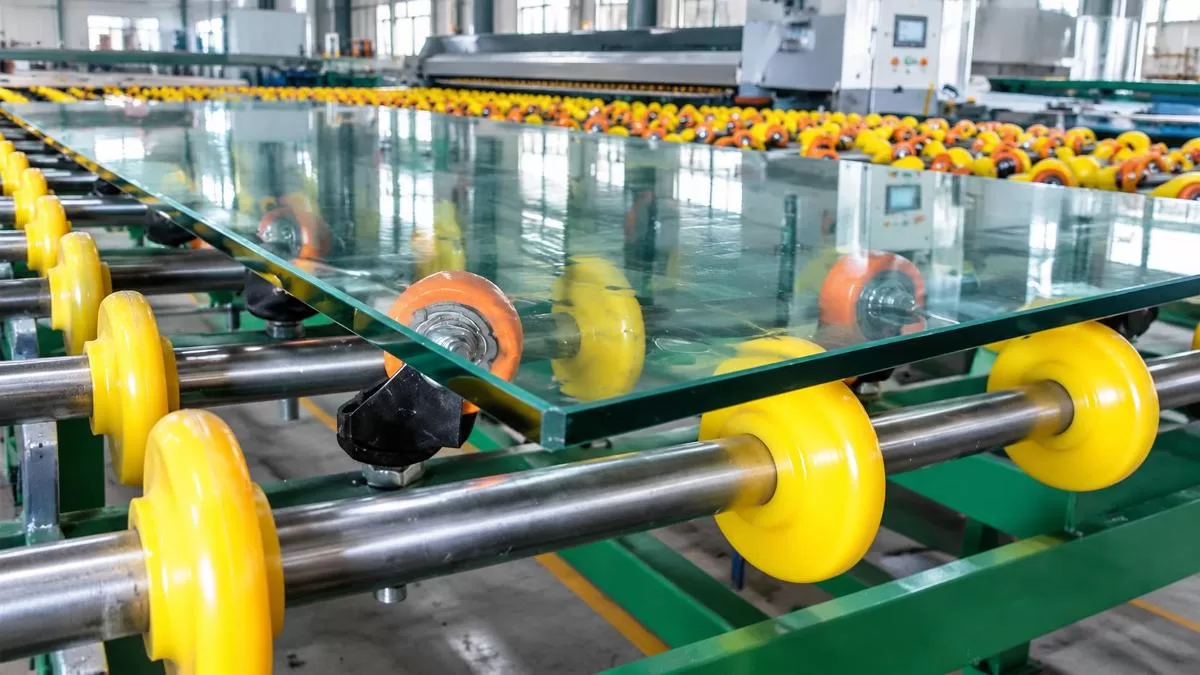
Investing in modern glass seaming machinery can meaningfully reduce edge-related fracture risk before flat glass enters a thermal tempering furnace. Freshly scored and snapped float glass carries an invisible hazard: microscopic fissures along the cut line that can propagate into breakage under furnace heat if left unaddressed. Proper edge seaming can reduce some of this edge-related breakage risk during tempering, though it cannot eliminate all causes of furnace failure. For architectural processors and industrial fabricators handling thousands of square meters daily, understanding the mechanics of industrial glass seaming equipment helps turn edge prep from a costly bottleneck into a more predictable, higher-yield operation.
Understanding Glass Seaming: Physics, Micro-Crack Removal, and Tempering Mechanics
Cutting flat glass is fundamentally a controlled fracture process rather than a true chip-forming operation. When a tungsten carbide scoring wheel traverses a float ribbon, it creates a narrow zone of high vertical compression directly beneath the contact point, accompanied by lateral tension. This mechanism creates a median crack extending into the core, alongside erratic lateral fissures that branch toward the surface.
When the sheet is mechanically broken, the resulting cut face can display fracture features such as a mirror zone near the score line, a mist zone of micro-roughness, and a rougher hackle zone further along the break. These features do not always form as sharply bounded regions in a fixed order, and the transitions between them can be gradual depending on the glass, the scoring tool, and the break itself. The sharp 90-degree corners bordering the top and bottom surfaces retain micro-flaws, commonly termed Griffith defects, which can act as stress risers during subsequent mechanical or thermal loading.
The Anatomy of a Cut Edge: Why Micro-Fissures Can Contribute to Furnace Breakage
Thermal tempering heats float glass to a temperature suitable for the tempering process, generally in the range cited for soda-lime glass processing, followed immediately by rapid air quenching to put the outer surfaces into compression while the core cools into tension. The exact heating and quenching parameters depend on glass thickness, composition, and furnace design, so operators should follow their furnace manufacturer's recommended settings rather than a single fixed figure. This transient thermal gradient induces considerable localized tensile stress along the outer edges during the opening seconds of the chill cycle.
If the glass perimeter retains raw cut corners, the tensile forces concentrate at the roots of those minute Griffith flaws. When the stress intensity factor at a flaw exceeds the glass's fracture toughness, the crack at that flaw can propagate rapidly, potentially across the entire sheet. The result can be breakage inside the furnace, scattering glass fragments across the ceramic hearth and forcing downtime for cleanout.
Automated arrissing grinds away the vulnerable corner tips at an angle, usually around 45 degrees. By removing the uppermost and lowermost edge boundaries, the machinery reduces the micro-flaws where tensile fractures tend to originate, which can help the edge better withstand the stress of a fast quench.
Seaming vs. Grinding vs. Polishing: Functional Differences and Edge Geometry
Fabricators often blur the terminology separating seaming, pencil edging, flat grinding, and brilliant polishing, yet each serves a distinct functional and economic purpose. Misapplying these processes wastes machine hours, accelerates diamond abrasive wear, and unnecessarily inflates operating expenditure.
Seaming, also referred to in some specifications as arrissing, focuses strictly on the two transitional corners of the edge profile. It does not attempt to remove the full cut face or deliver an optically smooth surface across the glass thickness. Flat grinding, by contrast, removes the entire raw cut face down to a calibrated dimension, creating a uniform matte surface, while polishing adds cerium oxide or resin wheels to achieve architectural optical clarity.
| Process Type | Primary Tooling | Removal Profile | Primary Objective |
|---|---|---|---|
| Arrissing / Seaming | Fine diamond belts or peripheral cup wheels | Top and bottom 45° chamfers, typically a fraction of a millimeter to a couple of millimeters | Reduce Griffith flaws to support tempering survival and safer manual handling |
| Rough Flat Grinding | Coarse metal-bond diamond wheels | Full edge face plus deliberate top/bottom arris | Dimensional calibration, squareness correction, and IG unit edge clearance |
| Fine Polishing | Resin-bonded diamond, rubber, and cerium wheels | Full face smoothing and optical finishing | Exposed decorative edges, frameless shower enclosures, and structural balustrades |
Selecting arrissing over full edge polishing can reduce cycle times and diamond consumable costs, since less material needs to be removed. For structural glazing, spandrel lites, and insulated glass units where edges remain hidden inside curtainwall mullions, automated seaming can deliver adequate mechanical reliability without paying for cosmetic gloss.
Core Technologies in Glass Seaming Machinery: From Manual Belts to In-Line Double Edgers
Fabrication facilities handle edge preparation through several tiers of technology: manual dry/wet cross-belt sanders, multi-axis robotic seaming cells, and continuous horizontal double edger lines. Choosing among them affects plant throughput, labor dependency, and finished edge repeatability.
Manual and semi-automated cross belts remain popular among small bespoke workshops, but high-volume architectural processors often find them harder to scale. The continuous in-line double edger represents a common choice for high-throughput production floors, moving raw cut panels toward a washed, furnace-ready state in a continuous pass.
Manual & Cross-Belt Seamers: Operational Limits and High-Yield Bottlenecks
Manual cross-belt seamers employ two rotating abrasive belts arranged in an X configuration, with the operator guiding the glass sheet by hand through the intersection. While mechanically simple and inexpensive to install, this approach introduces notable process instability.
Operator fatigue directly compromises arris consistency over an eight-hour shift. Manual feed rates vary, causing localized over-grinding on corners and under-seaming along sheet midpoints. Even slight hand tremors can create edge scallops, which may become potential thermal fracture points inside the tempering furnace. Furthermore, dry cross belts generate airborne glass particulates, and facilities should assess the specific dust composition and workplace exposure levels to apply suitable dust control and ventilation measures.
When processing jumbo architectural lites weighing upwards of two hundred kilograms, manual handling risks operator injury and glass slippage. Relying on manual seamers can create an unpredictable production bottleneck right behind high-speed automated cutting tables.
High-Throughput Double Edging Production Lines: Continuous Automated In-Line Seaming
Industrial glass processors resolve these capacity limits by installing continuous horizontal double edging lines. Rather than handling individual edges sequentially, these automated systems convey the glass horizontally across rigid machine beds, processing one pair of opposite, parallel edges simultaneously with diamond grinding assemblies positioned on each side.
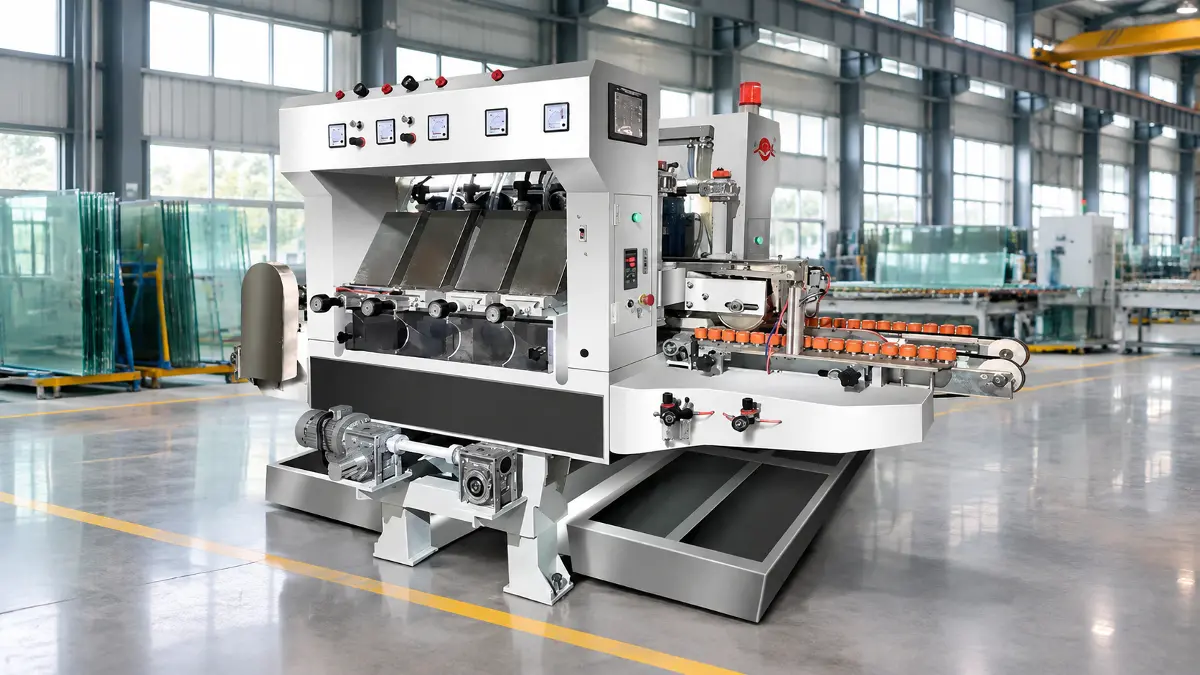
In an automated double edger line, glass typically enters via an input conveyor that positions and squares the lite before it reaches the grinding section. The specific squaring and workholding mechanisms vary by machine design and should be confirmed against the actual equipment specification rather than assumed as standard. Diamond grinding wheels are positioned along both edges as the glass passes through, and the resulting edge profile, whether an arrissed chamfer, a flat ground face, or a round pencil edge, depends on the tooling selected for the configuration; fabricators should confirm which wheel type and edge outcome apply to their specific line with the manufacturer before specifying the machine as a seaming solution.
Continuous horizontal conveyance reduces edge deflection on thin glass while still accommodating multi-laminate panels. Actual conveyance and feed speeds vary by machine configuration and glass type, so fabricators should confirm the specific throughput figures for their chosen line configuration with the manufacturer rather than assuming a fixed rate. Keeping the grinding load consistent across the pass helps limit mechanical micro-chipping.
Wet vs. Dry Seaming Mechanisms: Coolant Control and Wheel Condition
Grinding soda-lime glass generates localized friction at the tool-workpiece interface. Without adequate coolant flow, heat and fine glass swarf can build up at the contact zone, which may affect edge quality if left unmanaged.
-
Wet Grinding Thermal Quenching: Flooding the tool-workpiece interface with water streams helps carry away friction heat and loose debris from the grinding zone.
-
Diamond Matrix Flushing: Pressurized coolant helps prevent fine glass swarf from loading into the diamond wheel matrix. A cleaner wheel face supports more consistent cutting action and can reduce tool glazing.
-
Fine Particulate Suppression: Liquid lubrication captures glass swarf at the point of origin, channeling the abrasive slurry into centralized filtration or sedimentation systems rather than dispersing it into the workshop atmosphere.
-
Coolant Quality Management: Using recycled water laden with settling particles can cause micro-scratching on the glass surface. Many lines integrate grinding coolants and closed-loop filtration to help maintain cleaner water delivery.
Whether wet grinding extends diamond abrasive lifespan compared to dry operation, and by how much, depends on the wheel specification, machine setup, and process conditions. Fabricators should follow the equipment and wheel manufacturer's recommendations for their specific application rather than assuming a fixed improvement.
Machine Sizing & Layout Engineering: Customizing Double Edger Lines for Industrial Floors
Integrating glass seaming machinery into a functional plant demands careful layout engineering and spindle specification. Equipment builders configure production lines around glass thickness ranges, daily square-meter targets, and factory floor dimensions.
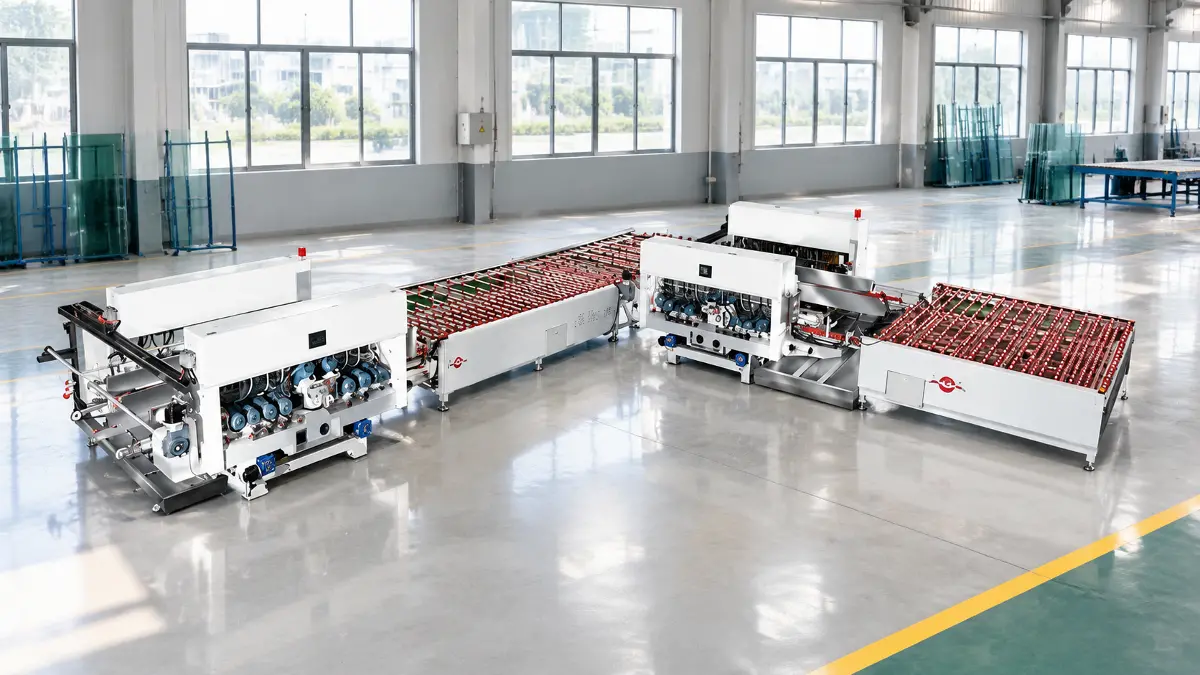
For us at LIAODA (LAD) Glass Machinery, drawing on our Yuanda manufacturing heritage in Foshan, machine design focuses on modular flexibility. Our Fully Automatic Glass Double Edger Machine Line reflects this approach, integrating glass loading, straight-line or round edging, and downstream washing into a continuous industrial workflow designed for architectural and furniture glass manufacturing.
Spindle Capacity Configuration (2 to 11 Spindles per Side): Matching Tooling to Glass Thickness
Spindle capacity defines the processing versatility and achievable feed speed of a double edger. According to the product specifications, this line offers configurations ranging from 2 up to 11 spindles per side, allowing fabricators to tune grinding profiles according to production requirements.
The exact split between arrissing stations, flat-grinding stations, and polishing stations within that 2-to-11 range depends on the target edge type, glass thickness, and finish quality for a given order. As a general pattern across the industry, fewer spindles tend to suit simpler arrissing or basic edging tasks, while higher spindle counts can support additional grinding and finishing stages. The precise tooling layout for any given spindle count should be confirmed directly with the manufacturer based on your intended edge profile.
Matching spindle counts to your core product mix helps avoid over-investing in unnecessary spindle maintenance while still supporting the feed speeds needed to keep pace with downstream tempering furnaces.
Factory Footprint Optimization: Straight-Line vs. L-Shape Automated Layouts
Double edging lines process rectangular glass on all four sides by linking two edgers together via an automated transfer mechanism. The first double edger processes one pair of opposite, parallel sides, after which the sheet is reoriented and the second edger processes the remaining pair. The plant designer must choose between an in-line straight configuration and a 90-degree L-shaped arrangement, as reflected in the straight-line and L-type layouts offered for this product line.
-
Straight-Line Configuration: Glass exits the first double edger after its first pair of parallel sides is processed, is transferred and reoriented by 90 degrees, and feeds into the second double edger along the same directional axis to process the remaining pair of sides. This configuration generally requires a long, narrow workshop bay.
-
L-Shape Configuration: The glass exits the first machine and is transferred onto a path set at a 90-degree angle, where it is reoriented and fed into the second machine to process the remaining pair of sides. The specific transfer hardware used to lift and redirect the sheet depends on the machine design and should be confirmed with the manufacturer. This compact setup makes efficient use of rectangular factory halls, reduces linear footage requirements, and can position the line exit closer to tempering furnace loading zones.
Both configurations are designed to maintain continuous workpiece synchronization, reducing the need for intermediate racking or manual glass rotation between edge passes.
Integrated Modular Automation: Loading, Thickness Scanning, Safety Corners, and Washing
Modern glass seaming machinery rarely operates as an isolated island of automation. Instead, it functions as the central core of an integrated workcell that ties cutting output toward the furnace loading conveyor.
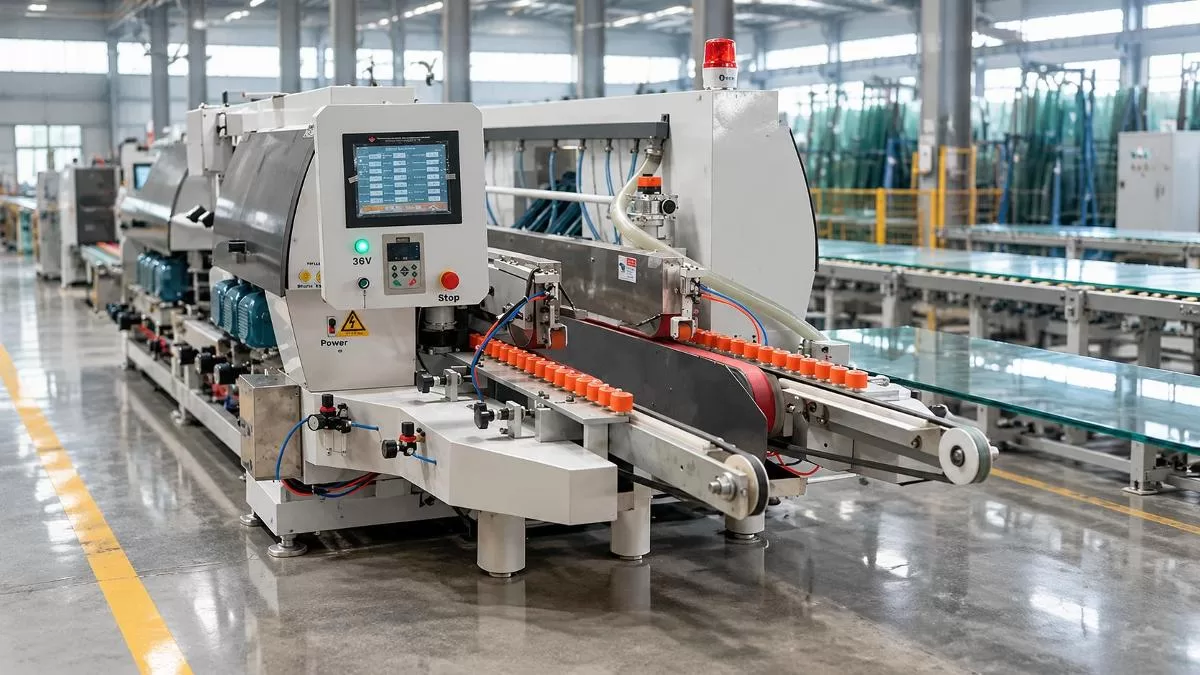
According to the product data, a complete double edging line can incorporate several interconnected equipment stations that work together, generally including:
-
Automatic Loading Machine: A loading unit lifts raw cut sheets from storage frames or cutting breakout tables, depositing them onto the intake conveyor with consistent registration.
-
Optional Thickness Scanning Table: Listed among the available upgrades, a scanning table can measure the incoming glass gauge. Whether and how the control system adjusts conveyor track widths or spindle depths based on that reading depends on the specific configuration, and should be confirmed with the manufacturer.
-
Safety Corner Processing: Sharp 90-degree glass corners pose handling risks and are prone to impact chipping. This optional corner processing feature is designed to address the four corners as the glass moves through the line.
-
Glass Transferring Table: Connects the double edging machines, supporting directional indexing between processing stages without manual intervention.
-
Glass Washing Machine: A washing unit equipped with brushes and drying sections removes glass swarf, diamond grit, and water residue before the glass proceeds toward tempering.
Integrating these automated modules can reduce the amount of manual handling required compared with manual edge processing, though actual staffing needs depend on line configuration and overall plant workflow rather than a fixed operator count.
Operational Best Practices: Preventing Tool Wear, Roller Contamination, and Breakage
Achieving consistent run rates from automated seaming lines requires disciplined preventive maintenance and process monitoring. Edge quality anomalies can quickly degrade downstream processing yield if operating parameters drift out of tolerance.
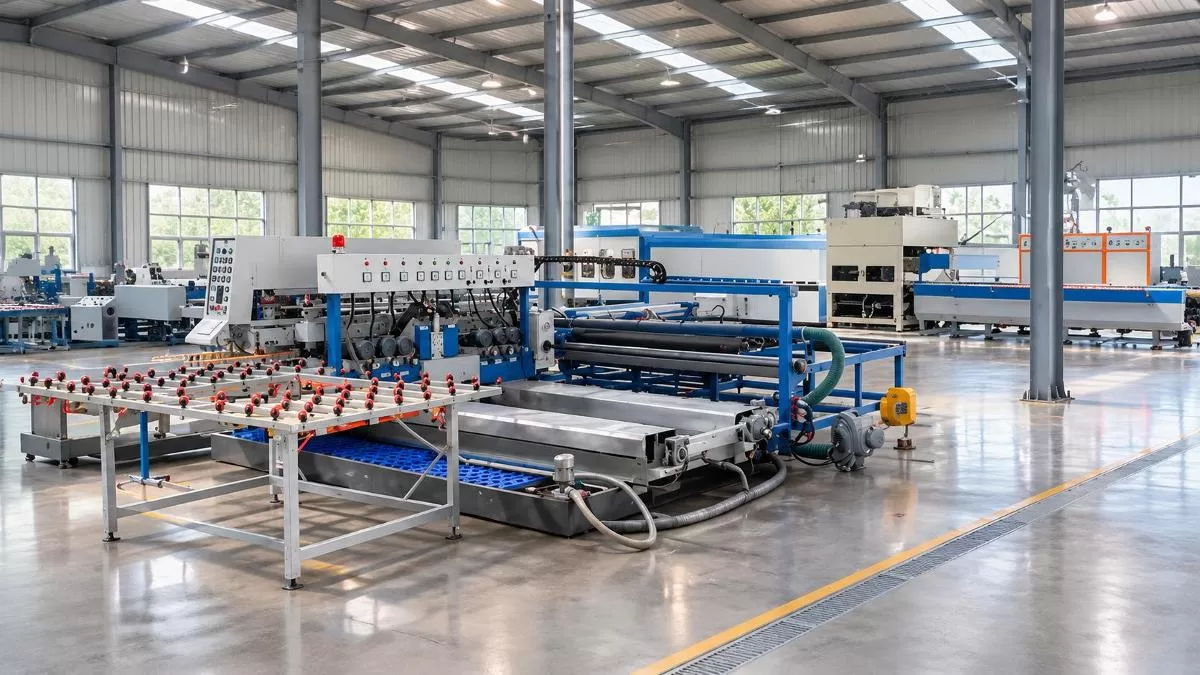
Feed Speed, Grinding Pressure, and Diamond Wheel Wear Compensation
Seaming consistency depends on a combination of factors rather than any single number: feed rate, wheel rotational speed, the depth of grinding engagement, coolant delivery, and the condition of the diamond wheel all interact to determine edge quality. If feed speeds accelerate without a proportional adjustment in spindle speed or coolant delivery, individual diamond grains can experience excessive shear force, which can cause premature pullout from the metal bond matrix.
Operators should monitor spindle drive motor current on the central control panel where available. A gradual rise in motor amperage often indicates wheel glazing, which occurs when glass swarf fills the bond pores, increasing mechanical friction against the glass. Operators should then dress the diamond wheels using suitable dressing sticks to strip away glazed bonding agent and expose fresh diamond cutting facets. For the specific feed rates, wheel speeds, and dressing intervals suited to a given machine and wheel combination, fabricators should follow the machine and wheel manufacturers' process guidance rather than a generic formula.
Some intelligent control systems support wheel wear monitoring and compensation features, though the specific mechanism, whether manual dressing schedules or automated servo-driven adjustment, varies by machine model. Fabricators should confirm which wear compensation capabilities apply to their specific line configuration with the manufacturer rather than assuming a particular method.
Protecting Furnace Rollers: Particle Elimination and Post-Seam Washing Quality
A subtle yet consequential failure mode in glass processing plants centers on the relationship between arrissing quality and ceramic tempering roller longevity. Inadequately dressed seamers can produce micro-shelling along the glass edge, meaning delicate flakes that cling loosely to the perimeter.
When a lite bearing loose edge particles enters the oscillating hearth of a tempering furnace at high temperature, those glass fragments can shed onto the ceramic rollers. The heat may cause stray particles to soften and adhere to the ceramic cylinder surfaces.
Once a ceramic roller picks up fused glass nodules, it can emboss scratches or indentation marks onto the bottom surface of subsequent glass lites passing over it. Cleaning or replacing affected ceramic rollers is costly and can halt furnace production for an extended period.
Maintaining rigorous in-line washing standards helps reduce this risk. Multi-stage washing machines linked directly to double edgers typically combine water rinsing with angled air knives to strip away microscopic glass chips and slurry residue, so that cleaner, dry glass reaches the furnace loading bed.
FAQs: Industrial Glass Seaming Machinery and Edge Pre-Processing
What is the primary difference between glass seaming and full flat edging?
Glass seaming, or arrissing, grinds away only the sharp top and bottom 45-degree corners of the cut glass edge, leaving the center cut score largely intact. Its primary role is mechanical: reducing micro-cracks to help lower the risk of thermal breakage during tempering and to support safer handling. Full flat edging grinds away the entire edge face down to a smooth, uniform surface, establishing exact exterior dimensions and producing a cosmetic finish suitable for exposed architectural applications.
Why is edge seaming generally recommended prior to horizontal glass tempering?
During horizontal thermal tempering, glass passes through rapid thermal cycling followed by high-pressure cold air quenching. This chill cycle induces significant, transient tensile stresses around the outer perimeter of the glass sheet. If the sharp 90-degree corners contain microscopic fissures from the cutting wheel, those flaws can act as stress concentrators that contribute to panel breakage inside the furnace. Seaming chamfers these corners, removing many of the micro-crack sites where such failures tend to start, though it is one of several factors that influence overall tempering success.
Can a double edger line process both straight-line flat edges and round edges?
According to the product specifications, this type of double edging machine line can be configured for either double straight-line edging or round edging. The exact tooling changes, spindle mounts, and changeover procedure needed to switch between these two edging types depend on the specific machine configuration and should be confirmed directly with the manufacturer.
How does an automated thickness scanning table help prevent wheel collision and glass jamming?
An automated thickness scanning table, available as an optional upgrade on this line, uses sensors to measure the thickness of each incoming glass panel before it enters the first double edger. That reading can be used by the control system to help flag or adjust for thickness variation, such as a thicker panel mixed into a batch of thinner stock, though the exact scope of automatic adjustment depends on the configuration and should be confirmed with the manufacturer. This capability is intended to help reduce the risk of wheel collisions, motor stalls, and edge damage.
What factors determine whether a factory should install a straight-line or an L-shaped edging line?
The decision between a straight-line and an L-shaped double edger configuration depends on workshop layout, floor length, and plant logistics. Straight-line setups require a continuous linear building bay with a transfer and reorientation stage positioned between the two edgers. L-shaped layouts use a transfer path set at a right angle to turn the processing direction. This design makes efficient use of rectangular workshop bays and can position the line exit closer to adjacent washing and furnace loading zones.
Conclusion: Maximizing Yield and Line Reliability
Selecting the right glass seaming machinery can help turn pre-furnace edge preparation from a hazardous bottleneck into a steadier contributor to plant-wide efficiency. By replacing manual cross-belt handling with higher-capacity automated double edger lines, glass fabricators work toward more consistent chamfers that support the demands of thermal tempering, while recognizing that machine setup, maintenance, and process control all play a role in results. With spindle platforms configurable from 2 to 11 grinding stations per side, optional thickness scanning, and in-line washing integration, commercial glass seaming machinery can offer a useful degree of operational consistency for architectural and industrial facilities aiming to safeguard product quality, protect furnace rollers, and support daily output targets.
CONTACT US


LIAODA (LAD) Glass Machinery Co., Ltd.
We are always providing our customers with reliable products and considerate services.
If you would like to keep touch with us directly, please go to contact us
-
![Home]()
Home
-
![Tel]()
Tel
-
![Email]()
Email
-
Share
-
![Contact]()
Contact


