
Glass Bevelling Polishing Machinery: The Complete Engineering and Selection Guide for Precision Edge
- By:LiaoDA
- Date:2026-10-22
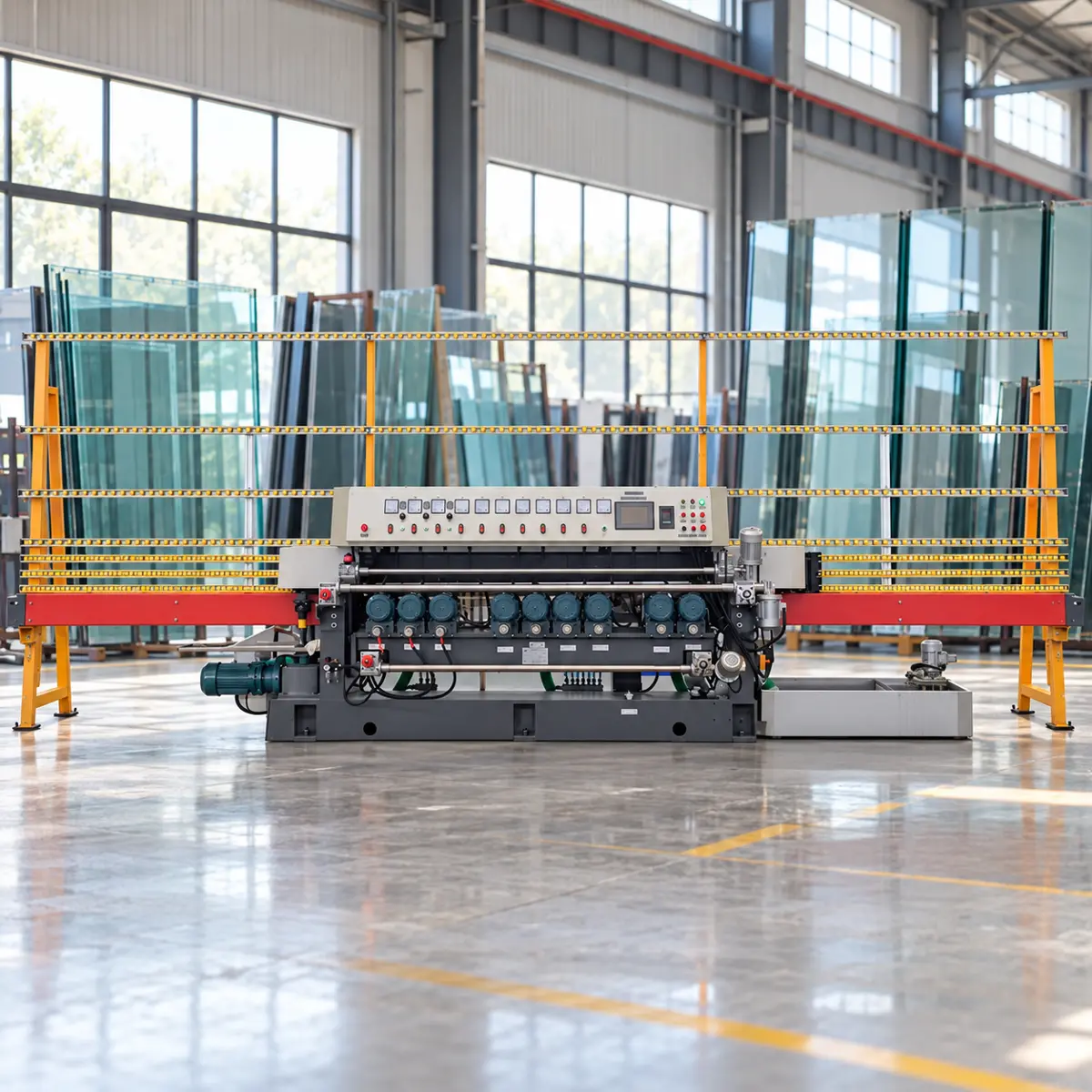
Why Edge Optical Clarity Defines Value in Glass Bevelling Polishing Machinery
Walk onto any architectural glass fabrication floor, and you will quickly notice where the scrap bin fills up fastest. Raw float glass rarely fails during initial straight-line scoring, yet profit margins evaporate when a panel reaches the beveling line. Investing in reliable glass bevelling polishing machinery determines whether a workshop delivers crystal-clear prismatic edges or struggles with costly re-polishing cycles.
When a decorative mirror or thick tabletop leaves the conveyor with a faint milky band along the miter line, high-end furniture buyers reject the entire batch immediately. That rejection happens so frequently in mid-sized workshops because glass is brittle and prone to edge defects under mechanical stress. Cutting a wide bevel requires careful control to avoid subsurface damage that appears as cloudy lines under angled lighting.
If the machine frame vibrates or the spindle progression skips an intermediate grit size, deep subsurface fissures remain trapped beneath the polished surface. Under angled showroom lighting, those hidden fissures scatter light and appear as a stubborn grey haze. Solving this optical defect requires matching spindle geometry, coolant hydrodynamics, and pneumatic polishing pressure within a single rigid chassis.
Rather than treating grinding and polishing as separate workshop bottlenecks, integrated vertical straight-line systems process the raw edge from coarse diamond stock removal to final cerium oxide buffing in one continuous pass. Understanding how these mechanical sub-systems interact allows plant managers to select equipment that protects both delicate mirror silvering and production throughput.
The Mechanics of Beveling and Polishing: Why Micro-Fractures Happen and How Spindles Fix Them
Every beveled edge begins as an aggressive geometric transition across the face of a flat glass sheet. Because standard float glass is brittle and exhibits low thermal conductivity, localized friction at the wheel-to-glass interface can trigger microscopic conchoidal fractures. A multi-spindle machine reduces edge chipping risks by dividing the workload across nine to eleven specialized grinding and polishing stations.
Stage 1: Coarse and Fine Material Removal with Metal-Bond Diamond Wheels
The initial spindles on a straight-line beveling bench may carry metal-bond diamond cup wheels. Sintered bronze or steel matrices hold coarse diamond abrasive grains firmly in place, grinding away the bulk of the glass volume to establish the target bevel angle and width. Without high-rigidity spindle bearings at this initial stage, wheel runout creates rhythmic wave patterns along the bevel face that no downstream polisher can erase.
Aggressive stock removal comes with a hidden physical trade-off. Coarse diamond grit ploughs into the silicate network and leaves behind a jagged topography of peaks and subsurface cracks below the visible plane. Operators must balance conveyor feed speed against wheel load so the wheels shear material cleanly rather than crushing the glass edge, which would deepen the subsurface damage layer.
Stage 2: Transitioning Surface Roughness via Resin-Bond Diamond Spindles
Jumping directly from coarse grinding wheels to felt polishing pads is a classic mistake that ruins workshop productivity. Felt pads cannot remove deep mechanical striations; they merely round over the edges of existing scratches, creating an orange-peel texture across the bevel.
To bridge this gap, intermediate spindles may utilize resin-bond diamond wheels with progressively finer grit classifications. Resin bonds offer slight microscopic elasticity compared to rigid sintered metal matrices. As the glass panel glides past these transition spindles, the resin-bond wheels shave away the fractured subsurface layer left by the coarse stage and reduce surface roughness to a uniform matte satin finish. By the time the glass exits the final resin wheel, the bevel geometry is flat, true, and ready for chemical-mechanical polishing.
Stage 3: Pneumatic Felt Polishing and Cerium Oxide Slurry Dynamics
Final optical transparency happens at the rear spindles, where polishing wheels may work with cerium oxide slurry or other polishing compounds. Unlike diamond grinding, which is purely mechanical, cerium oxide polishing involves a wet chemical-mechanical reaction that softens and smooths the hydrated silica surface layer at the molecular level. Achieving high-quality edge polish requires constant, compliant contact pressure across the entire width of the bevel.
On the YD-BM series vertical mirror and glass edge beveling machine, a dedicated pneumatic polishing system regulates polishing pressure. The system consumes less than 1 liter per minute of compressed air and is designed to deliver consistent contact pressure throughout the polishing cycle.
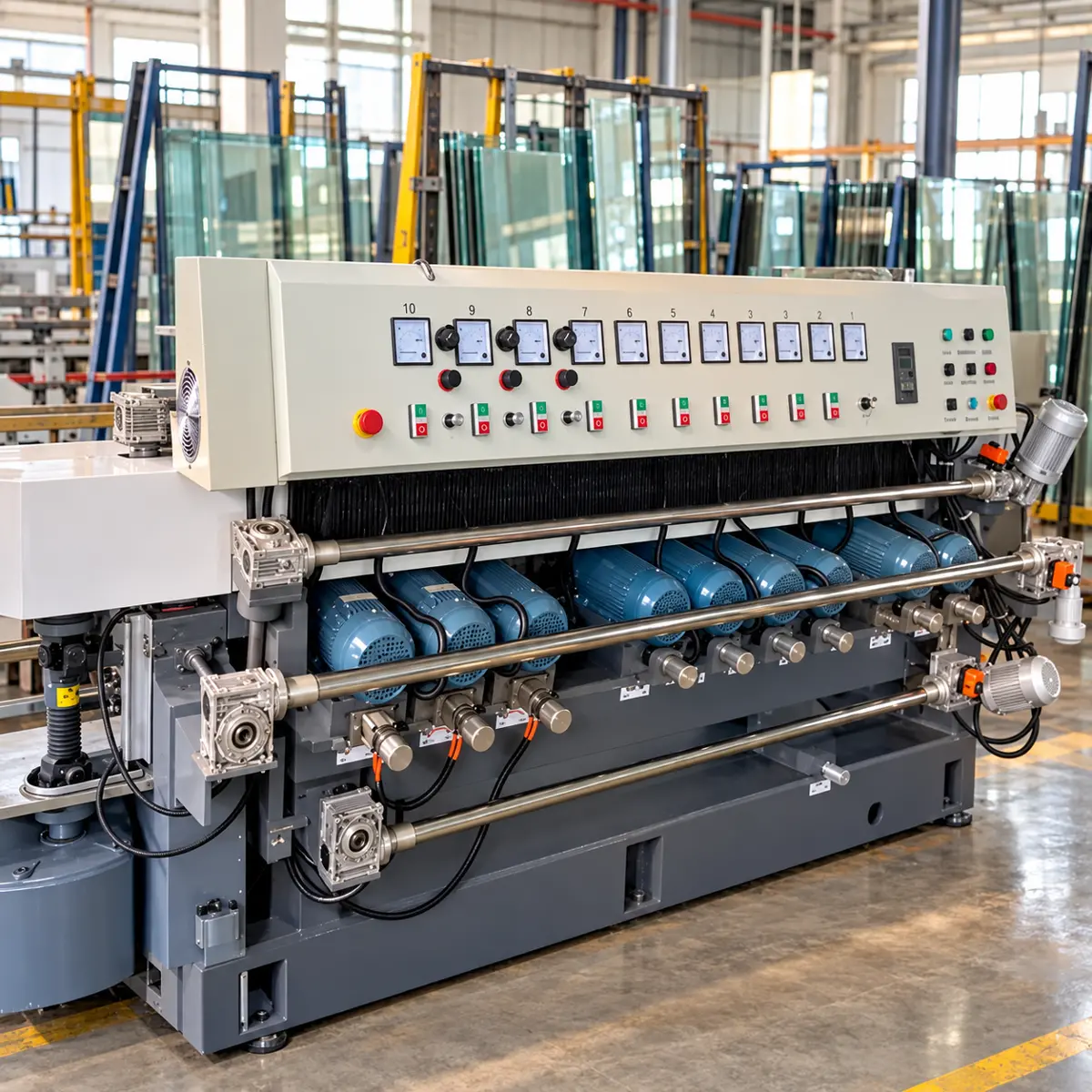
Architectural Configurations: Comparing Vertical Straight-Line, Shape, and Double-Edging Systems
Floor space and product variety dictate which machine architecture belongs in a fabrication facility. A workshop producing bespoke oval vanity mirrors faces completely different mechanical constraints than a high-volume contract glazier turning out thousands of rectangular wardrobe doors. Selecting the wrong machine layout forces operators into awkward manual handling that slows down cycle times and increases breakage.
Why Vertical Straight-Line Beveling Machines Dominate Mirror and Flat Glass Workshops
For straight-edged rectangular or square panels, vertical straight-line beveling machines represent the industry workhorse. Because the glass travels at a slight incline against an overhead support rack, gravity helps stabilize tall sheets while occupying a narrow floor footprint of just 1.2 meters in width. The vertical orientation allows gravity-fed cooling water and abrasive swarf to drain directly into the lower recirculation tank rather than pooling on top of the glass surface.
In contrast, rotary shape-edging machines use vacuum suction platforms and articulated grinding arms to follow curved templates or circular table tops. Horizontal double-edging lines process two parallel edges simultaneously for massive architectural curtain wall runs, though they demand substantial factory width and complex transfer conveyors. For most mirror, furniture, and decorative glass processors, the vertical straight-line configuration strikes the most practical balance between floor efficiency, quick angle adjustment, and low maintenance.
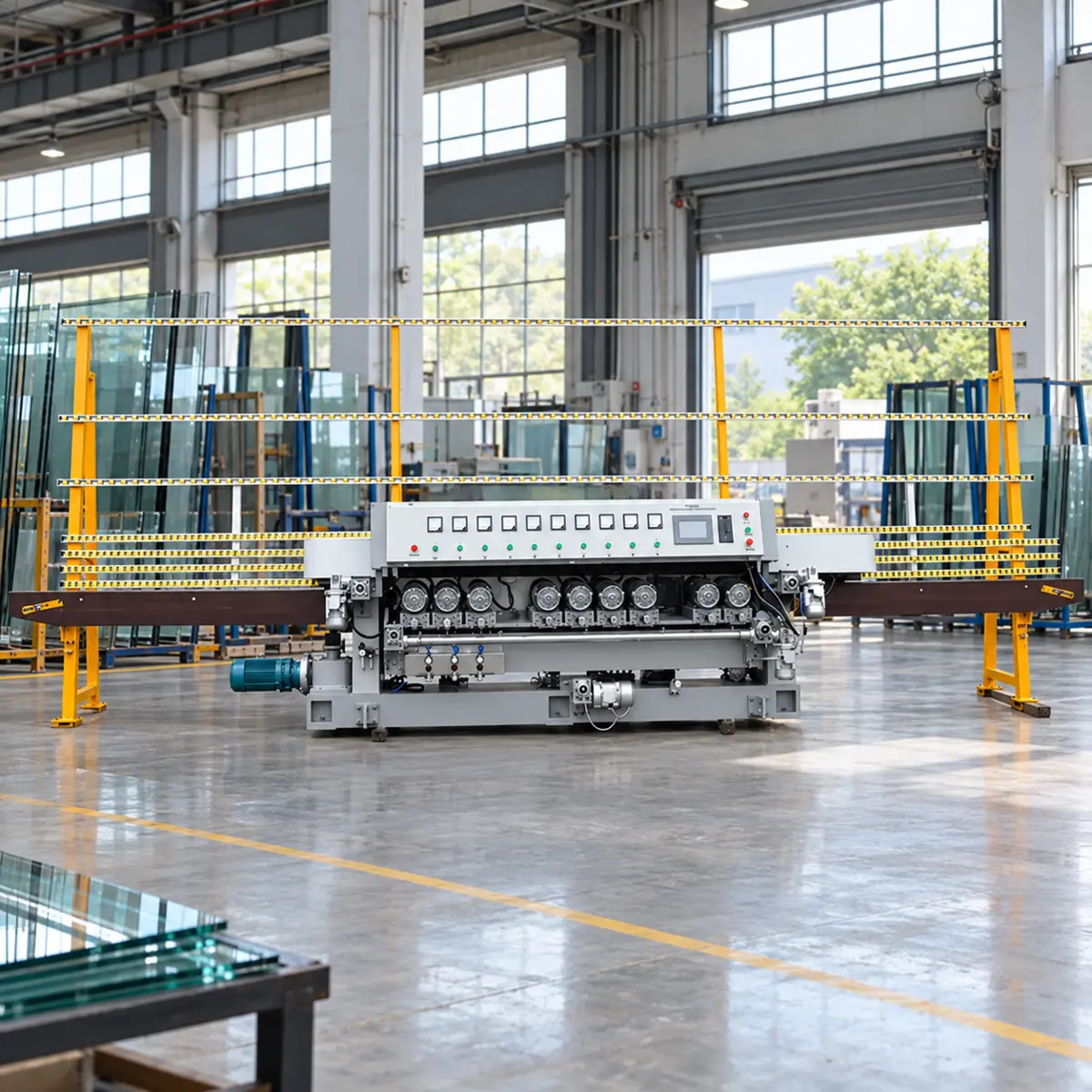
Handling Extreme Dimensions: From 30x30mm Mosaic Tiles to Heavy Architectural Panels
One counter-intuitive challenge in vertical glass processing is that tiny glass pieces are often harder to bevel accurately than heavy two-meter sheets. When a small glass tile enters a standard conveyor track, it bridges fewer drive pads; if the clamping pressure wavers, the spinning cup wheels can twist the tile out of alignment and jam the track. Thick 19 mm architectural panels require immense torsional stability from the drive motors to prevent belt slippage.
To address both extremes, the YD-BM series pairs synchronized feed spindles with heavy-duty timing belt drives and stable electric motors. Standard configurations comfortably handle panels starting at 150x150 mm. The YD-BM-10S model features a front-beam hoist system and can process glass pieces down to 30x30 mm, while the YD-BM-10-45 also handles mosaic pieces as small as 30x30 mm, according to the manufacturer's specifications. Whether feeding delicate decorative tiles or 19 mm structural glass, the synchronized drive maintains a steady linear travel speed.
Inside the YD-BM Series: Technical Specifications and Model Selection Matrix
Evaluating industrial glass bevelling polishing machinery requires looking past surface aesthetics and examining the exact mechanical envelope of each model. Developed by LIAODA (LAD) Glass Machinery Co., Ltd., a Foshan-based manufacturer whose engineering roots date back to the 1990s and whose Yuanda brand equipment operates across more than 100 countries and regions, the YD-BM series weighs between 3,000 and 4,000 kg, providing the structural mass needed to maintain stability during continuous grinding and polishing operations.
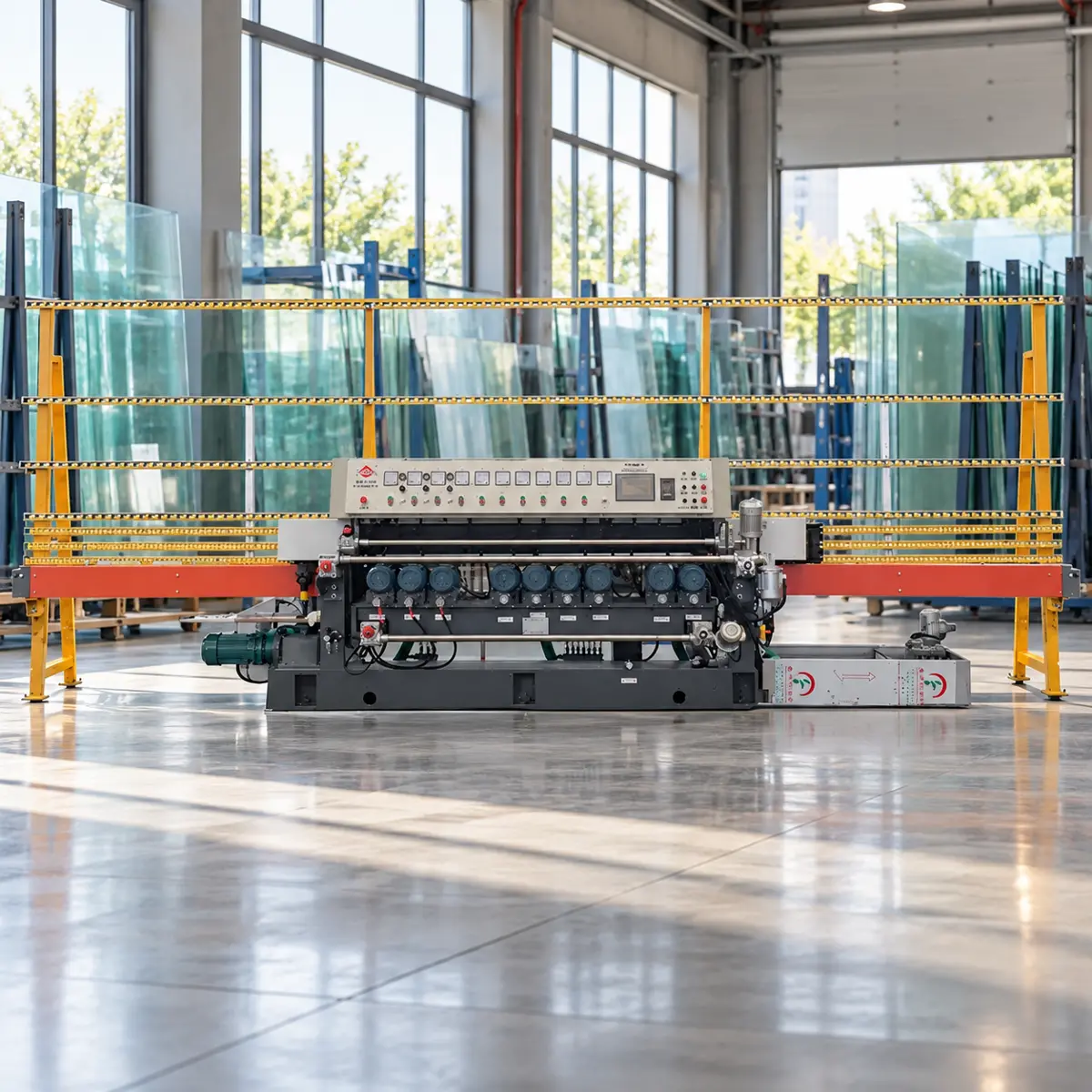
Breakdown of YD-BM Series Specifications
The YD-BM series encompasses multiple configurations to accommodate different production requirements, from small mosaic tiles to full-size architectural panels. The series includes models such as the YD-BM-9, YD-BM-10, YD-BM-10S with front-beam hoist for small glass, YD-BM-10-45 for steep-angle beveling, and YD-BM-11 for high-capacity operations. According to the manufacturer's product specifications, the series offers the following capabilities across its model range:
| Specification Parameter | YD-BM Series Range |
|---|---|
| Total Number of Spindles | 9 to 11 Spindles |
| Max. Beveling Width | 35 to 40 mm |
| Bevel Angle Range | Up to 30° (standard models); up to 45° (YD-BM-10-45 model) |
| Glass Thickness Capacity | 3 to 19 mm |
| Minimum Glass Size | 30 x 30 mm (YD-BM-10S, YD-BM-10-45); 150 x 150 mm (standard models) |
| Processing Speed | 0.8 to 3 m/min (infinitely variable) |
| Total Installed Power | 21 to 25 kW |
| Compressed Air Consumption | < 1 L/min |
| Machine Outer Dimensions | Approximately 7.0 to 7.5 x 1.2 x 2.6 m |
| Machine Net Weight | 3,000 to 4,000 kg |
When reviewing these specifications for plant integration, engineering teams should focus on several core operational indicators that affect daily production. Matching the machine's capabilities to your product mix, floor space, and throughput requirements prevents costly mismatches between equipment capacity and actual workshop needs. The manufacturer indicates that grinding spindles can be customized to meet specific processing requirements.
- Spindle Allocation and Polishing Capacity: Machines with 10 to 11 spindles offer additional stations that can be configured for specific grinding or polishing operations, which may help support wider bevels and varied production schedules.
- Steep-Angle Miter Capability: The YD-BM-10-45 model processes bevel angles up to 45 degrees, supporting seamless miter-joint glass showcases and furniture assemblies that require steeper edge angles.
- Low Pneumatic Overhead: Because the pneumatic polishing system consumes less than 1 liter per minute of compressed air, the equipment's compressed air demand is modest. Buyers should confirm the required air pressure and total plant demand with the supplier when selecting compressor capacity.
- Versatile Substrate Compatibility: The drive and spindle geometry accommodates clear float, tinted, frosted, and silvered mirror glass within the 3 to 19 mm thickness window. Beveling and edge grinding should be completed before any tempering or strengthening process, according to the manufacturer's application scenarios.
Manual Controls vs. PLC Touch Screen Automation: Which Fits Your Production Floor?
Selecting between manual push-button controls and a PLC touch screen interface depends heavily on how often your operators change glass thicknesses and bevel angles during a shift. The YD-BM series offers both control architectures so buyers can match the machine interface to their workforce habits and batch profiles.
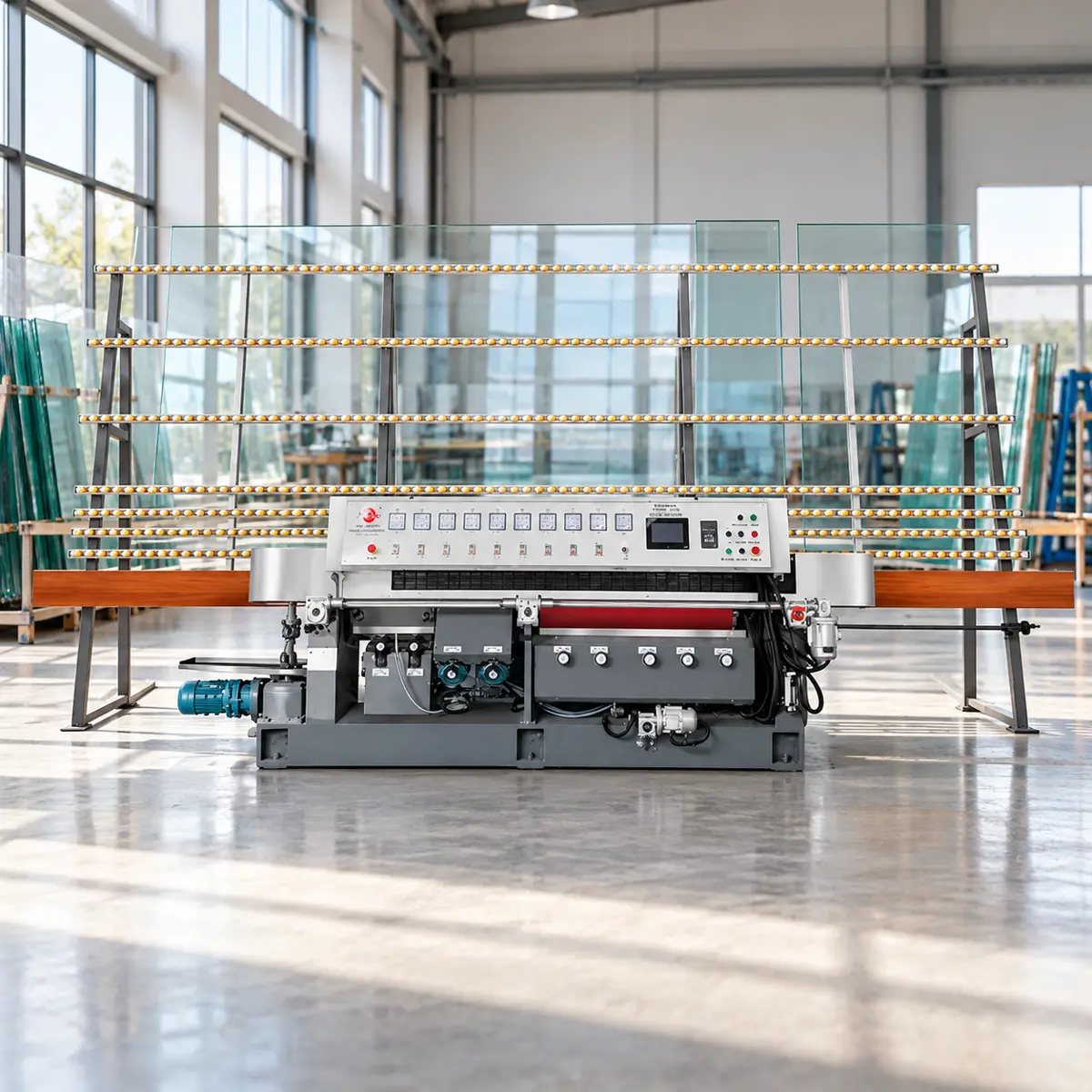
If a factory runs identical bathroom mirrors at a fixed bevel angle for extended periods, manual control panels with analog gauges provide straightforward, tactile reliability without the complexity of digital interfaces. Job shops handling multiple custom orders per shift benefit from the PLC touch screen option, which can simplify parameter adjustment and reduce setup time between different glass specifications.
Step-by-Step Operational Protocol for Calibrating Your Glass Bevelling Polishing Machinery
Even a four-ton industrial beveler will produce inconsistent edges if the operator sets up the spindle depths out of sequence. Establishing a disciplined calibration routine before feeding production glass prevents wheel glazing, circuit trips, and thermal stress cracks. Operators should consult the manufacturer's operating manual and work with the equipment supplier to confirm machine-specific setup procedures.
Pre-Production Setup Sequence
Before starting any production run on glass bevelling polishing machinery, operators typically follow a systematic calibration sequence to ensure all mechanical and control systems are functioning correctly. While specific steps vary by machine model and manufacturer, a general approach includes verifying coolant flow across all grinding stations, setting the machine geometry to match the incoming glass thickness and target bevel dimensions, and running test pieces to confirm spindle loads are balanced from coarse grinding through final polishing stages.
Machines with pneumatic polishing systems require activation of the air system on the polishing spindles. Operators inspect test pieces under direct lighting to confirm the polished edge meets optical clarity standards before committing production glass to the line. Any persistent haze or grinding marks indicate that spindle progression, wheel condition, or system settings need further adjustment according to the operating manual.
Calibrating Feed Speeds for Different Glass Specifications
How fast should the conveyor run during active production? The YD-BM series features infinitely variable speed regulation, allowing operators to dial linear travel speeds anywhere between 0.8 and 3 meters per minute while the glass is in motion. The appropriate feed speed depends on the glass thickness, bevel width, wheel setup, and desired finish quality.
Thinner glass with narrow bevels generally allows faster conveyor speeds because the diamond wheels remove less total material. Thicker architectural panels requiring wide bevels up to 40 mm typically run at slower speeds to give the grinding and polishing wheels sufficient contact time to erase deep grinding lines and restore optical clarity. Operators balance production throughput against edge quality by inspecting finished edges throughout each shift and adjusting machine parameters as needed.
Preventing Edge Damage and Mirror Backing Degradation During Processing
Mirror fabrication requires careful attention to protect the reflective coating and backing layers. Standard decorative mirrors consist of float glass coated with a reflective silver layer, copper, and protective backing paint. During edge processing, maintaining adequate cooling water flow and keeping diamond wheels properly dressed helps ensure clean cutting action that minimizes heat generation at the glass edge.
Processors should follow the mirror manufacturer's fabrication guidelines to protect backing integrity throughout grinding and polishing operations. Promptly cleaning and drying processed mirrors prevents moisture from reaching the backing seal. Regular wheel maintenance using appropriate dressing sticks keeps the diamond grit sharp and free-cutting, supporting efficient material removal throughout the production shift.
Frequently Asked Questions About Glass Bevelling Polishing Machinery
How many spindles are required for a distortion-free mirror bevel?
For commercial mirror and furniture glass processing, machines with 9 to 11 spindles provide multiple stations for grinding and polishing operations. The YD-BM series offers configurations across this range, with bevel widths reaching 35 to 40 mm depending on the model. The YD-BM-10-45 specifically supports bevels up to 40 mm wide at angles up to 45 degrees. The final edge quality depends on the installed wheels, their condition, operating parameters, and processing requirements rather than spindle count alone.
Can you bevel and polish glass after it has been tempered?
Beveling and edge grinding must be completed on annealed glass before it enters the tempering furnace. Grinding operations on fully tempered glass disturb the surface compression layer that gives tempered glass its strength, creating stress concentrations that can cause spontaneous fracture. Any edgework requirements should be finished before the strengthening or tempering process. If a machine manufacturer claims compatibility with tempered glass for specific operations, confirm those capabilities directly with the supplier before processing tempered panels.
Why does a white haze remain on the bevelled edge after polishing?
A persistent white or grey haze can result from several causes in the grinding and polishing sequence. If a resin wheel is worn out, misaligned, or if the grit progression skips a necessary intermediate step, deep fractures from the coarse grinding wheels may remain too deep for the final polishing stages to remove completely. Check wheel condition, alignment, the complete grit sequence, and polishing setup. Replacing worn wheels and verifying proper progression typically resolves this issue.
What is the minimum glass size a vertical straight-line beveling machine can process safely?
Standard industrial vertical bevelers typically require a minimum glass dimension of 150x150 mm to span enough conveyor pads for stable clamping and tracking through the grinding and polishing stations. Specialized small-glass models such as the YD-BM-10S and YD-BM-10-45 can securely hold mosaic and decorative glass pieces as small as 30x30 mm, according to the manufacturer's specifications.
How much compressed air and electrical power does an industrial beveling machine consume?
A full-sized 9-to-11 spindle vertical beveling machine in the YD-BM series requires 21 to 25 kW of electrical power to drive its grinding spindles, water pumps, and synchronized conveyor motors. The pneumatic polishing system consumes less than 1 liter per minute of compressed air. Buyers should confirm the required air pressure and assess their total plant compressed air demand when selecting compressor capacity to support the equipment.
Conclusion: Building Long-Term Edge Quality and Production Efficiency
Choosing the right glass bevelling polishing machinery comes down to matching mechanical rigidity and spindle progression to your workshop's daily product mix. Whether your production floor focuses on 30x30 mm decorative mosaic tiles, 45-degree mitered display cases, or wide 40 mm architectural bevels on 19 mm glass, consistent optical clarity relies on synchronized conveyor feeds, precise grinding-to-polishing transitions, and compliant pneumatic polishing systems. By evaluating spindle configurations, control interfaces, and minimum clamping dimensions upfront, glass fabricators can eliminate secondary hand-buffing bottlenecks and deliver flawless beveled edges straight off the line.
CONTACT US


LIAODA (LAD) Glass Machinery Co., Ltd.
We are always providing our customers with reliable products and considerate services.
If you would like to keep touch with us directly, please go to contact us
-
![Home]()
Home
-
![Tel]()
Tel
-
![Email]()
Email
-
Share
-
![Contact]()
Contact


