Innovation in Glass Lamination Machinery: Engineering Trends, Upstream Tempering Synergy, and Line Selection
- By:LiaoDA
- Date:2026-10-27
Recent innovation in glass lamination machinery has reshaped how architectural and automotive fabricators approach multi-layer safety glazing. Plant managers searching for automated glass lamination machinery innovations often assume that replacing a pre-nip oven or upgrading an autoclave will immediately eliminate edge bubbles and delamination. In practice, a laminating line is only as precise as the heat-treated glass fed into its loading conveyor, and when two sheets of tempered glass enter a cleanroom assembly station, any surface irregularity carried over from the tempering furnace becomes one of the variables the lamination process has to work around.
Flatness is not the only factor behind delamination risk; interface bonding quality, interlayer handling, and process control inside the laminating line all play a role as well. Even so, vacuum de-airing systems and servo-driven nip rollers have less margin to compensate when a stiff structural interlayer has to bridge pronounced surface peaks and valleys on the glass beneath it. Understanding modern laminating equipment therefore requires looking at the broader thermal and mechanical chain rather than any single station in isolation. From convection-assisted heating zones in pre-nipping furnaces to controlled quenching in horizontal flat glass tempering lines, meaningful yield improvement tends to happen where upstream glass flatness and downstream bonding control are addressed together.
Why Glass Fabricators Seek Innovation in Glass Lamination Machinery
Rising Complexity of Structural and Acoustic Interlayers
For decades, standard polyvinyl butyral (PVB) was the dominant interlayer on commercial production floors. Operators could rely on relatively forgiving temperature windows and fixed pneumatic roller pressures to squeeze air from between two annealed glass lites. Today, hurricane-resistant facades, structural glass fins, and acoustic automotive windshields demand more complex polymer formulations, and that shift changes what the laminating equipment is expected to do.
Ionoplast polymers, multi-layer acoustic tri-layer PVB, and thermoset ethylene-vinyl acetate (EVA) respond differently to heat and mechanical compression than standard PVB does. Stiffer structural interlayers generally exhibit lower flow during pre-nipping, which means they conform less readily to irregular glass topography unless the assembly is heated in a controlled and even manner across its cross-section. Consequently, fabricators who process multi-layer laminates or thick security glazing on older, less uniform heating ovens tend to see higher reject rates. When heat does not penetrate the core of a thick assembly at a rate similar to the perimeter, the outer edges can seal before the interior air has fully escaped, trapping pockets inside the panel.
Energy Consumption and Cleanroom Environmental Pressures
Beyond material complexity, energy overhead is squeezing operating margins across the glass processing sector. Traditional laminating lines consume significant electricity in two specific areas: maintaining strict temperature and relative humidity inside the interlayer assembly cleanroom, and running prolonged high-pressure autoclave cycles. Upstream glass washing and drying stations also represent a notable utility draw before the glass ever touches an interlayer. Water-saving washing equipment addresses part of this bottleneck by combining optimized spray nozzle geometries with closed-loop cascade water recovery systems, which is a design approach aimed at reducing water consumption and mineral spotting rather than a fixed, universal percentage improvement.
By pairing efficient washing systems with better-controlled heating, plants can work toward lower kilowatt-hour expenditure per square meter of finished laminate. Reducing thermal waste inside the pre-nip furnace also limits how much radiant heat spills into the adjacent cleanroom, which in turn eases the cooling load placed on industrial dehumidifiers.
Core Technological Breakthroughs in Modern Laminating Lines
Convection-Assisted Heating and Infrared Zoning
The shift from simple radiant quartz lamps toward combined radiant-and-convection heating represents a meaningful change in pre-nipping technology. Low-E and other reflective coatings alter how a glass surface absorbs or reflects radiant heat, which can create uneven temperature gradients through the assembly when heating relies solely on infrared radiation. Modern laminating furnaces often circulate heated air through nozzle arrays above and below the roller bed alongside radiant elements, rather than relying on convection as a complete replacement for radiant heat. Automated control hardware and software adjust blower frequencies and heater outputs to help even out the heating profile across coated and uncoated glass, which fabricators use to process structural laminates of varying thickness without relying purely on infrared exposure time.
Because forced air transfers some of its thermal energy by direct contact with the glass and interlayer surfaces, convection assistance can help reduce the gradient that reflective Low-E coatings introduce when heating is radiant-only. The goal is for the interlayer to reach a usable tack temperature more evenly from center to edge, which supports clearer escape paths for trapped air ahead of the nip rollers.
Servo-Driven Pre-Nipping Rollers and Vacuum De-Airing Systems
Once the glass sandwich exits the heating zone, mechanical pressing must expel residual air without crushing the glass perimeter or squeezing out softened polymer. Older pneumatic cylinders apply force with a noticeable mechanical lag, often causing a heavy impact when the leading edge of a thick laminate enters the roller gap. Some newer or application-specific pre-nipping systems use closed-loop servo-electric drives instead of pneumatic actuators; availability and control features vary by line.
Advanced pre-nipping systems may include features such as dynamic gap profiling, where servo motors adjust the vertical roller opening based on the line recipe, and synchronized conveyor drive, where independent frequency inverters match the tangential speed of the pressing rollers to the main roller table to reduce shear slippage between glass plies. Crown compensation designs, which adjust roller surface profiles to account for deflection under high pressure, and reinforced support structures are other features found on certain equipment designed for wide architectural lites; the specific approach depends on the line manufacturer and application.
For specialized applications such as complex curved automotive components or certain solar encapsulates, dedicated vacuum ring or flexible diaphragm systems may be used to help evacuate edge air prior to thermal bonding, though these are not standard features on general-purpose flat glass pre-nipping lines.
Final Lamination Methods: Autoclave Curing and Autoclave-Free Alternatives
Pre-nipping is a preparatory de-airing and tacking step; the final optical bond itself is completed in a separate curing stage, typically either a high-pressure autoclave or an autoclave-free vacuum lamination furnace. Choosing the right curing architecture depends on daily production volume, interlayer chemistry, and facility floor space, and the table below should be read as illustrating general equipment categories rather than fixed parameters for every line.
| Technology Parameter | High-Pressure Autoclave (final cure) | Servo Pre-Nip Stage (pre-cure de-airing) | Vacuum-Bag EVA Furnace (final cure) |
|---|---|---|---|
| Role in Process | Final high-pressure bonding cycle | Air removal and tack-bonding before final cure | Final bonding cycle under vacuum, no autoclave |
| Typical Interlayer Compatibility | Standard PVB, Acoustic PVB, Ionoplast | Used upstream of most interlayer types | Thermoset EVA, Decorative Inserts, TPU |
| Typical Pressure or Vacuum Range | Compressed air cycles in the low-bar range | Mechanical nip roller pressure, not autoclave pressure | Vacuum pump drawing a negative-pressure range |
| Typical Thermal Cycle | Multi-hour elevated-temperature cycle | Continuous inline heating, shorter dwell time | Batch chamber heating cycle |
| Common Production Profile | High-volume architectural and automotive safety glass | Used across most laminating lines regardless of volume | Lower to medium volume specialty, smart film, and interior glass |
Autoclave-free vacuum ovens are commonly used for encapsulating wire mesh, PET smart films, and decorative fabrics using EVA, while high-capacity architectural lines still generally pair continuous pre-nipping with a final autoclave cure. Autoclave control systems commonly use circulation fans and cooling stages to help manage temperature uniformity inside the pressure vessel, though the precise tolerance achieved depends on the specific equipment and load.
The Hidden Bottleneck: Why Lamination Yield Depends on Upstream Tempering Flatness
How Roller Wave, Edge Lift, and Overall Bow Affect Lamination Bonding
A useful comparison is trying to glue two corrugated metal sheets together using a thin piece of double-sided tape. If the peaks and valleys of both sheets do not align closely, the tape only touches the high points, leaving gaps in between. Tempered glass lamination faces a related challenge, though the underlying mechanisms are specific to glass and glass is not corrugated metal.
When float glass is heated near its softening range on ceramic rollers, geometric distortions can develop during tempering. Periodic roller wave distortion can create alternating peaks and valleys along the travel direction. Edge lift, sometimes called edge curl, can cause the leading and trailing portions of the glass perimeter to bend upward due to uneven cooling near the edges, and an overall bow can introduce a broader concave or convex curve across the panel when top and bottom surface temperatures are not well balanced. These forms of distortion are one factor among several that influence lamination quality; thinner interlayers generally have less capacity to conform to an uneven glass surface than thicker ones. Rather than citing a single universal flatness threshold, fabricators and glass suppliers typically agree on acceptable roller wave and edge lift limits as part of a specific project's glazing specification, since there is no single industry-wide numeric standard that applies to every glass type and application.
Precision Thermal Control with the Horizontal Flat Glass Tempering Furnace YD-F
Addressing these geometric variables starts with the thermal process used before the glass ever reaches the laminating cleanroom. For us at LIAODA (LAD) Glass Machinery Co., Ltd., located in Foshan City, Guangdong Province, China, this upstream stage has been part of our engineering focus since the 1990s; after establishing Yuanda Glass Machinery in 2000 and adopting our current company name in 2005 with Yuanda as our brand name, our hot and cold glass processing machines have been deployed across China and over 100 countries and regions worldwide.
According to the manufacturer's product information, the Horizontal Flat Glass Tempering Furnace YD-F is designed to provide laminating lines with glass processed using more uniform heating and controlled quenching, with flatness as a stated design objective, by integrating a Beckhoff intelligent control system. Rather than letting heating elements cycle crudely on and off, the control architecture is intended to manage thermal distribution across both the surface area and the thickness of the glass.
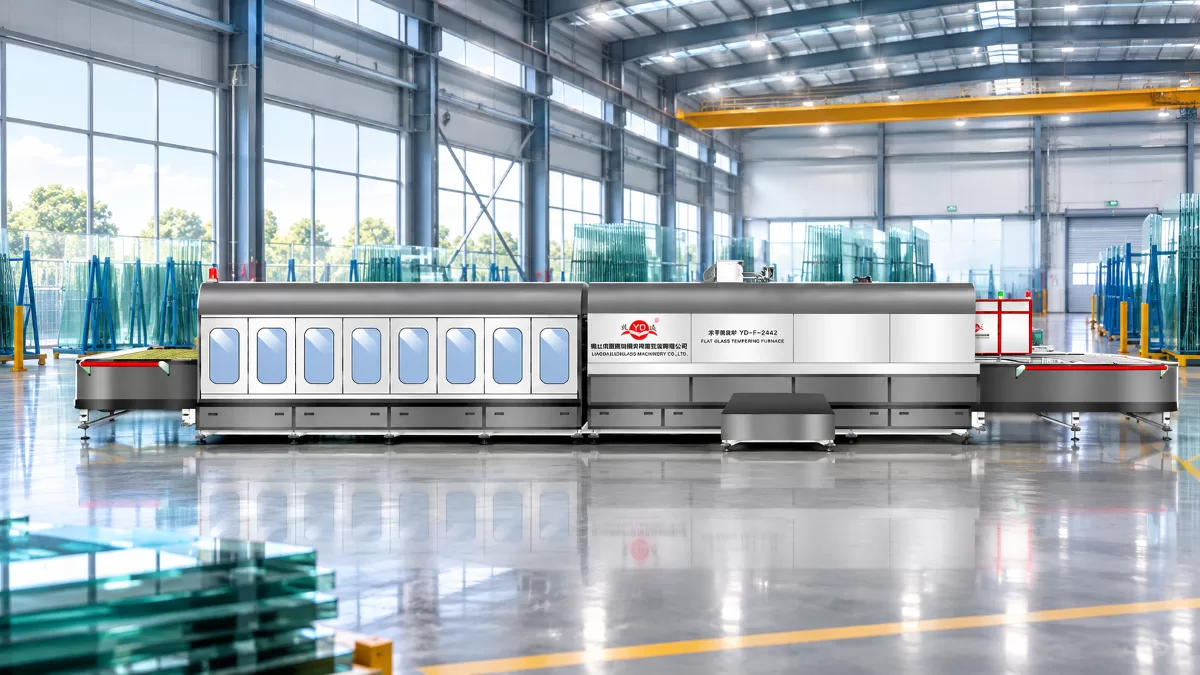
The stated heating element layout is designed to help reduce cold spots that can cause localized glass stiffening and roller marking. The manufacturer's design intent is for the top and bottom surfaces of the glass to approach the target quenching temperature together, which is meant to help the sheet stay closer to flat against the ceramic conveyor rollers and reduce the kind of curling that can complicate downstream pre-nipping; actual results will still depend on glass specification, loading, and maintenance.
Quenching Aerodynamics and Technical Specifications for Laminated Glass Substrates
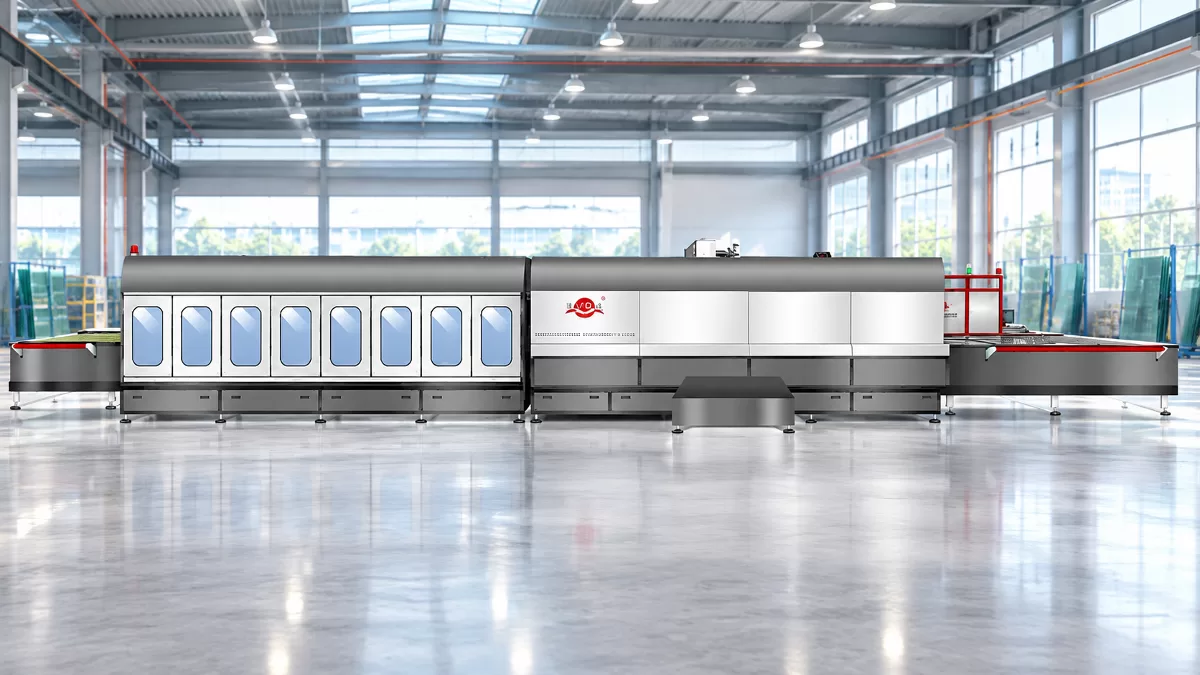
Heating uniformity is only part of the flatness picture; the quenching section also has a significant role in setting that geometry. If cooling air strikes the glass unevenly, differential shrinkage can lock warp and optical anisotropy, visible as strain patterns, into the tempered lite. According to the product design of the YD-F series, a specially engineered quenching system and nozzle geometry are intended to deliver more balanced cooling conditions across both surfaces of the glass. This controlled air distribution is intended, per the manufacturer's description, to support optical clarity and surface flatness across a range of industrial applications, including architectural glass production, automotive glass manufacturing, train and ship glass components, bathroom glass fixtures, and household interior decoration glass.
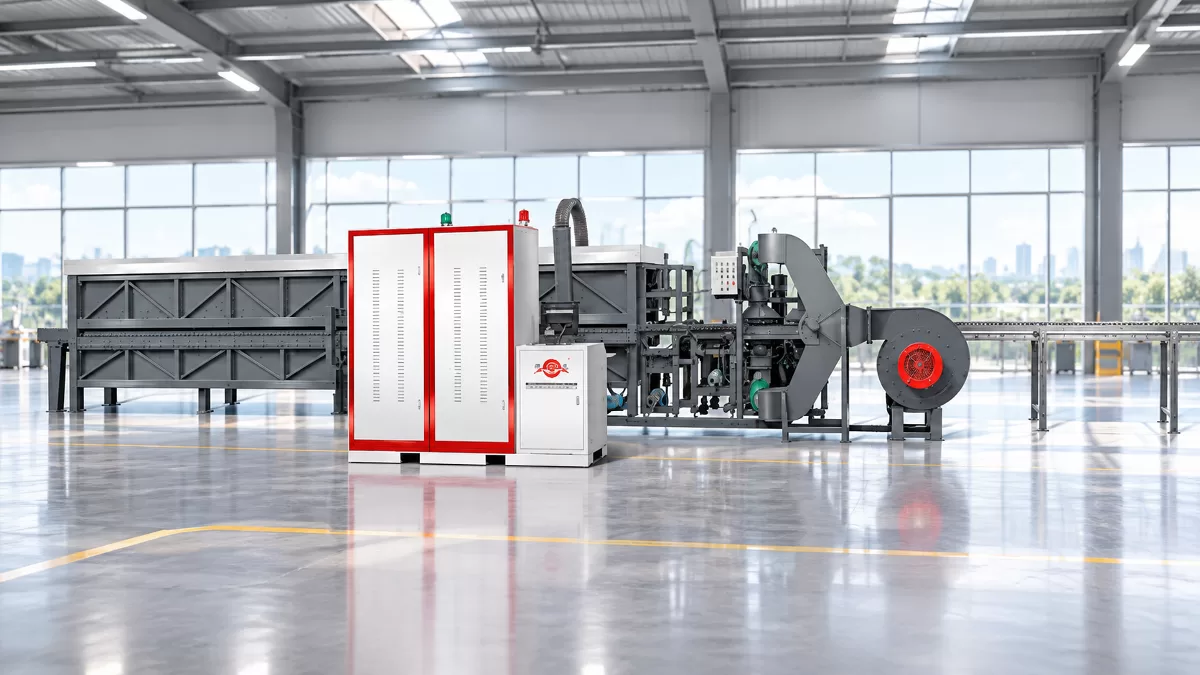
Below are the technical specifications of the Horizontal Flat Glass Tempering Furnace YD-F series, as supplied by the manufacturer, for plant engineers planning upstream capacity:
| Technical Parameter | YD-F Series Specification Range |
|---|---|
| Processable Glass Thickness | 4 mm to 19 mm |
| Maximum Glass Dimensions | 1250 x 2500 mm up to 3300 x 8000 mm (model dependent) |
| Minimum Glass Dimensions | 100 x 150 mm up to 100 x 400 mm (model dependent) |
| Installed Heating Power | 180 KW to 1584 KW |
| Total Machine Length | 13.5 m to 35 m |
| Production Output Capacity | 45 to 297 Sqm/Hour |
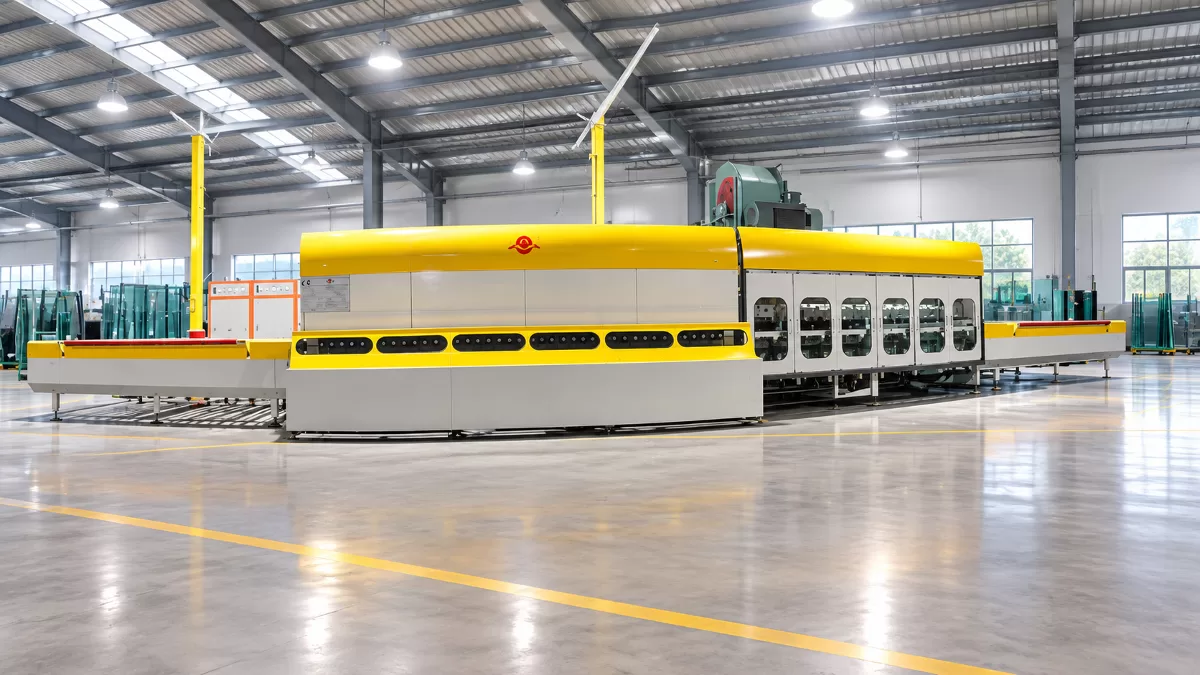
By matching the furnace bed size, ranging from compact 1250 x 2500 mm formats up to jumbo 3300 x 8000 mm architectural beds, to the maximum dimensions supported by the downstream laminating line, fabricators can ensure that the tempering and laminating equipment share compatible capacity and glass-size ranges.
How to Select and Integrate a High-Yield Tempering and Lamination Production Line
Step-by-Step Selection Framework for Glass Processors
Investing in new hot-processing and laminating machinery requires aligning mechanical capabilities with your commercial order book. Plant directors can avoid mismatched bottlenecks by following a structured five-step evaluation process:
-
Audit Your Maximum Glass Size and Thickness Mix: Determine whether your revenue comes primarily from standard interior partitions or oversized structural facades, and select a tempering bed (up to 3300 x 8000 mm on the YD-F series) and laminating nip width that share compatible maximum dimensions across 4 to 19 mm thicknesses.
-
Synchronize Hourly Throughput Rates: Calculate your target square meters per hour; because tempering outputs on the YD-F range from 45 to 297 Sqm/Hour depending on model and thickness, size your pre-nipping conveyor speed and curing stage volume so tempered lites do not accumulate in intermediate storage racks for days.
-
Confirm Pairing and Orientation Protocols: Work with your glass supplier or project specification to determine the orientation requirements for paired lites in a laminated unit. Maintaining consistent orientation for both lites, rather than mixing orientations, can help support flatness control; the specific approach should be validated for the glass type, tempering parameters, and acceptance criteria in use.
-
Verify Interlayer Thermal Compatibility: If your product roadmap includes structural ionoplast or multi-layer acoustic PVB, confirm with your equipment supplier that the laminating oven's heating profile and the upstream tempering furnace's heating zoning are suited to those specific interlayer types, since processing parameters still need to be validated per material and machine.
-
Validate Factory Footprint and Electrical Infrastructure: Measure total bay length (13.5 m to 35 m for the tempering line alone, plus cleanroom and pre-nip oven length) and confirm transformer capacity for heating loads between 180 KW and 1584 KW.
Digital Connectivity, Remote Diagnostics, and Lifecycle Maintenance
Hardware precision can drift over time if operators cannot monitor machine behavior in real time. Modern glass plants increasingly connect their tempering and laminating PLCs to centralized factory supervisory networks to track energy draw, roller oscillation timing, and zone temperatures. On the Horizontal Flat Glass Tempering Furnace YD-F, the Beckhoff intelligent control system is described by the manufacturer as supporting smart remote management, parameter modification, and automated malfunction diagnosis. The intent of this kind of diagnostics is to help flag a degraded heating element or an out-of-tolerance sensor reading sooner, rather than letting the furnace continue running with an undetected fault while warped lites move toward the laminating cleanroom.
Digital recipe management can also help reduce transcription errors between shifts, since operators recall saved heating and quenching parameters for specific glass thicknesses instead of re-entering them manually. This supports more consistent outcomes when a similar architectural order is produced again months later, though final flatness and optical quality still depend on glass quality, maintenance, and process discipline on the day of production.
Frequently Asked Questions About Innovation in Glass Lamination Machinery
Why do bubbles appear along the edges of tempered laminated glass after the autoclave cycle?
Edge bubbles can result from a combination of upstream edge lift carried over from the tempering process and premature edge sealing inside the laminating pre-nip oven, though bonding quality at the glass-interlayer interface and process timing can also contribute. If the perimeter of the tempered glass curls slightly due to uneven quenching, a small air gap can form along the border. When heat warms the outer edges of the interlayer faster than the interior, the polymer can seal the perimeter before the nip rollers finish pushing out the central air, which may leave trapped gas that expands into visible bubbles once autoclave pressure is applied and later released.
Can a single lamination line process both standard PVB and structural ionoplast interlayers at the same line speed?
Not necessarily at an identical speed in every case. Laminating furnaces that use convection-assisted heating and recipe-driven servo nip rollers are generally better equipped to handle a range of interlayer types than older infrared-only ovens, since they can adjust heating and nip parameters by recipe. Even so, the actual processing speed for ionoplast or thick multi-layer assemblies versus standard PVB still needs to be validated against the specific interlayer, glass makeup, and equipment configuration in use, rather than assumed to match automatically.
Is there a standard roller wave or edge lift tolerance required for defect-free lamination?
There is no single industry-wide numeric limit that applies uniformly across glass types and applications. Architectural glazing specifications vary by project, glass thickness, and measurement method, and acceptable roller wave and edge lift figures are typically set out in the specific project's or supplier's glazing specification rather than as a universal benchmark. Working toward tighter, well-controlled flatness generally supports better lamination outcomes, and features such as uniform heating across the glass thickness, precision ceramic rollers, and balanced nozzle quenching, as described for the YD-F series, are intended to support that goal.
How does automated malfunction diagnosis in hot-processing equipment affect total cost of ownership?
In laminated safety glass production, value accumulates at each stage: cutting, edging, washing, tempering, cleanroom assembly, pre-nipping, and final curing. If a faulty heating zone in the tempering furnace introduces subtle warp, the defect may not become apparent as a lamination problem until after the interlayer has been permanently bonded, at which point the glass and interlayer cost is already committed. Automated malfunction diagnosis is intended to help catch thermal or mechanical anomalies at the furnace stage earlier, which can reduce the risk of scrapping high-value laminated assemblies and shorten troubleshooting downtime, though it does not eliminate the need for routine inspection.
Conclusion: Building a Future-Proof Glass Processing Line
Evaluating innovation in glass lamination machinery requires looking beyond isolated cleanroom equipment and considering hot glass processing as a connected thermal and mechanical system. Servo-electric pre-nipping rollers, water-saving washing stations, and convection-assisted laminating ovens can meaningfully improve interlayer bonding, but their real-world yield still depends in part on the geometric flatness of the incoming heat-treated glass and on process discipline throughout the line.
By pairing modern laminating lines with upstream equipment such as the Horizontal Flat Glass Tempering Furnace YD-F, built around Beckhoff intelligent control, a heating design aimed at uniform distribution, and an optimized quenching system as described by the manufacturer, fabricators have another lever to address roller wave and edge lift closer to the source. Considered as part of a broader approach to innovation in glass lamination machinery, matching upstream tempering performance to downstream lamination equipment may support efforts to improve flatness and process consistency; actual optical quality, energy use, and output depend on the glass, line configuration, operating settings, and maintenance.
CONTACT US


LIAODA (LAD) Glass Machinery Co., Ltd.
We are always providing our customers with reliable products and considerate services.
If you would like to keep touch with us directly, please go to contact us
-
![Home]()
Home
-
![Tel]()
Tel
-
![Email]()
Email
-
Share
-
![Contact]()
Contact


