
Mastering High-Speed Edge Finishing: Engineering Guide to Automatic Glass Polishing Machinery
- By:LiaoDA
- Date:2026-11-06
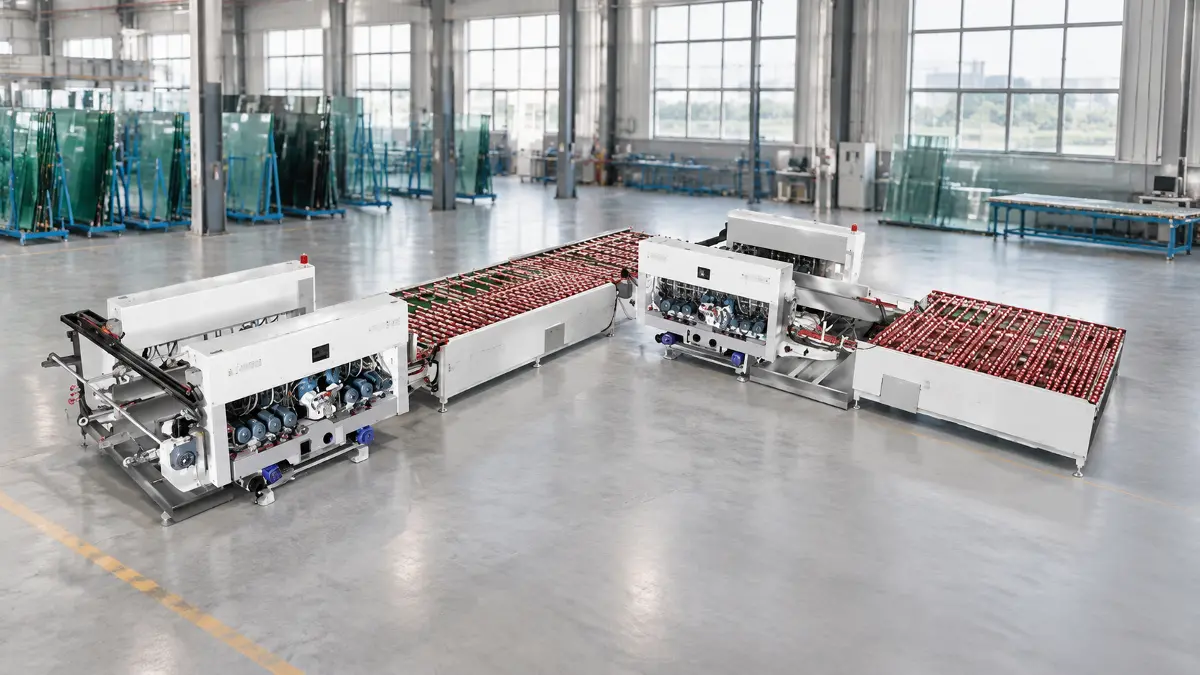
Modern architectural glazing and industrial glass processing demand rigorous standards of edge integrity, dimensional precision, and optical clarity. At high feed velocities, manual or semi-automated grinding methods can struggle to consistently reduce edge flaws or preserve exact geometric parallelism across thousands of square meters. Integrating industrial automatic glass polishing machinery has transitioned from an optional operational upgrade to a core engineering necessity. Modern processing lines use double edgers to execute rough grinding, fine resin smoothing, arris chamfering, and final polishing within a single automated pass, reducing production bottlenecks and, when properly configured and controlled, supporting a lower incidence of edge-related breakage during tempering.
The Physics of Glass Edge Finishing: From Micro-Fracture Removal to Optical Polish
Raw glass cut edges can contain flaws or chips. Scoring can produce median and lateral cracks, while other cutting methods leave their own edge conditions. When subjected to rapid temperature shifts in a tempering furnace, these edge flaws can propagate into fractures. Understanding edge finishing requires examining how mechanical stock removal transforms a rough cut surface into a smooth, polished edge.
Managing Chipping and Subsurface Damage in Diamond Grinding
Rotary diamond wheels remove glass primarily through brittle micro-fracture during early roughing cycles, where embedded diamond grits create controlled micro-chipping within the surface layer. If mechanical feed forces exceed practical thresholds, cracks can penetrate beyond the intended removal margin.
The practical aim of industrial edge finishing is to match wheel specification, depth of cut, and feed rate so that chipping and subsurface damage stay within an acceptable range for the glass and application. The precise balance between these variables depends on the wheel, the glass, and the machine's tooling, and should follow the manufacturer's operating guidance rather than a single fixed setting.
Reducing Edge Flaws to Help Prevent Furnace Breakage
Tempering can create transient tensile stresses during early heating. Severe edge flaws can contribute to premature fracture under those stresses; suitable edge finishing may reduce risk but cannot guarantee against breakage.
Consistent diamond profiling and sequential smoothing help remove edge notches, which manufacturers generally associate with improved structural yield rates for architectural lites during tempering, though the actual outcome depends on the finished edge quality and the glass itself.
Polishing Mechanisms: Abrasive and Chemical-Mechanical Approaches
Polishing differs from grinding because the final pass is meant to refine the surface left by coarser abrasives rather than remove bulk material through fracture. Depending on the machine configuration and tooling selected, polishing wheels may rely primarily on fine mechanical abrasion, or on a combined chemical and mechanical interaction, such as cerium oxide particles held in polyurethane or compressed synthetic matrices under flooded water conditions.
The exact mechanism behind cerium oxide polishing is understood to be complex, and glass-processing literature does not reduce it to a single simple reaction. What can be said conservatively is that fine abrasive polishing passes are intended to remove microscopic asperities left by earlier grinding stages, producing a clearer, smoother edge with fewer light-scattering ridges than a ground-only surface. The specific abrasive and tooling arrangement used on a given line depends on the machine configuration and the fabricator's process requirements.
Multi-Stage Spindle Kinematics: Inside an Industrial Polishing Line
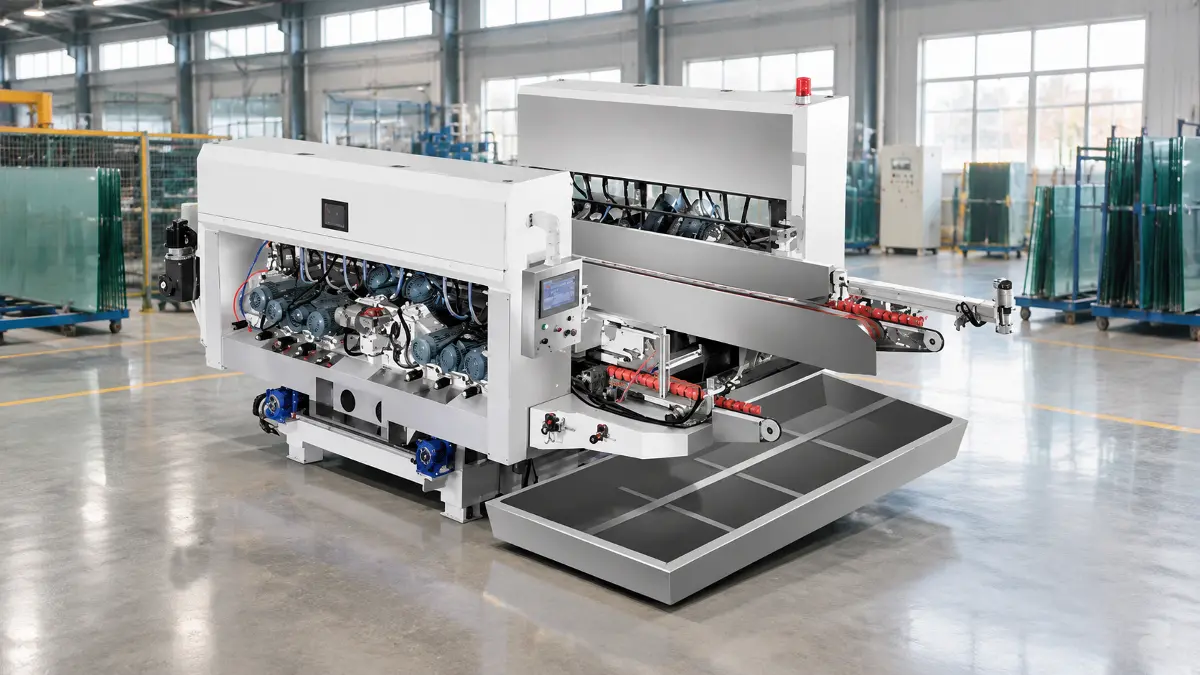
Processing architectural panels at continuous throughput calls for a cascaded grinding line. Glass passes through specialized spindle clusters that sequentially refine edge topography, from rough bulk excision to final polishing.
Metal-Bond Diamond Stations: Controlled Stock Removal
Initial processing commonly begins with coarse metal-bond diamond wheels, mounted on balanced, vibration-damped spindles. Grit selection for this stage varies by machine and tooling supplier, and should be set according to the specific wheel and machine manufacturer's recommendations rather than a single universal band. These wheels cut away the raw scored boundary, establishing panel width and correcting cross-cut variances.
Operating under heavy continuous water flood conditions, these primary stations remove significant stock without overheating the glass substrate. Precise wheel alignment helps ensure the raw glass face receives a uniform edge profile, which supports consistency in downstream runs.
Resin-Bond Diamond Stations: Surface Smoothing and Micro-Scratch Reduction
After metal-bond profiling, panels enter secondary and tertiary processing zones fitted with resin-bond diamond wheels, which use progressively finer grit than the roughing stage to reduce coarse tooling striations. The specific grit progression depends on the wheel series and machine setup and should be confirmed against the tooling manufacturer's recommendations.
Resin matrices compress slightly under contact load, cushioning abrasive engagement and dampening micro-vibrations across the glass substrate. This compliant step flattens tooling marks and prepares the edge for finer polishing wheels.
Pneumatic Polishing Spindles: Dynamic Contact Force and Surface Finish
Where a configuration includes pneumatic polishing spindles, such as the optional pneumatic polishing function noted in the YD-DE product data, these stations apply elastic finishing wheels to the glass edge using pneumatic pressure to maintain contact force. Rigid mechanical slide feeds cannot easily adapt to gradual wheel erosion, which can lead to burned contact points or cloudy sections.
Pneumatic cylinders supply a continuous, cushioned load against the passing glass edge to offset dynamic deflection. This controlled float is intended to compensate for abrasive wheel wear, supporting a more uniform finish across long glass sheets.
Safety Arris and Corner-Cutting Integration
Finished commercial glazing typically requires safety arris processing on both top and bottom corners to reduce handling cuts and ease sharp perimeter stress points. Dedicated angled spindles apply symmetrical chamfers along the seams, creating smoother load transitions.
Some automated systems also incorporate corner-cutting capabilities to trim sharp leading points before secondary processing. Removing sharp corner zones can reduce the risk of accidental corner impacts during high-speed transit across industrial conveyor transfers.
Core Architecture Analysis: Horizontal Double Edgers vs. Vertical Straight-Line Edgers
Selecting between vertical straight-line machines and horizontal double-edging production systems affects plant capacity, workforce configuration, and production speed. The comparison below reflects typical configurations; actual handling steps, transmission components, and tolerance outcomes vary by specific machine model and setup.
| Operational Parameter | Vertical Straight-Line Edger (typical) | Horizontal Double Edger System (typical) |
|---|---|---|
| Throughput Architecture | Commonly single-edge per cycle, with manual handling across passes | Parallel edges ground simultaneously in 1 pass, where the model supports double-edge grinding |
| Dimensional Squaring | Often dependent on operator squaring accuracy | May use a precision screw rod transmission, as confirmed for the YD-DE series |
| Handling Labor Load | Generally higher; manual loading and repositioning common | Generally lower; conveyor pass-through reduces manual repositioning |
| Footprint Geometry | Tall vertical profile, smaller floor area | Horizontal platform, requires more open factory space |
| Target Processing Profile | Often suited to small-batch, custom bespoke lites | Often suited to higher-volume window, curtain wall, and tile runs |
Processing Throughput: Single-Pass Parallel Edge Grinding vs. Multi-Pass Handling
Vertical straight-line edging commonly requires an operator to handle a lite across multiple passes to grind all edges, which introduces handling steps and can slow overall output depending on the specific setup. For heavy panels, repeated handling adds labor time at every stage.
Horizontal double edgers, including the YD-DE series, grind two parallel borders simultaneously in a single pass according to the manufacturer's product data. When paired with automated corner-transfer tables, connected machines can be arranged to process all four edges across two continuous stages with reduced manual repositioning, depending on the line configuration.
Structural Rigidity: Linear Guide Rails and Precision Screw Rod Transmissions
Dimensional consistency across broad panels depends directly on the structural rigidity of the underlying machine frame. Heavy structural steel bases are generally intended to absorb cyclic tool chatter and resist vibration transmitted through the frame.
For the YD-DE series specifically, the supplied specifications confirm a construction built on linear guide rails with screw rod transmission. This type of architecture is intended to resist mechanical flex under spindle thrust loads, which supports maintaining edge tolerances across continuous shifts, though actual tolerance outcomes depend on machine condition, maintenance, and setup.
Dimensional Tolerance Control: Squareness, Parallelism, and Diagonal Precision
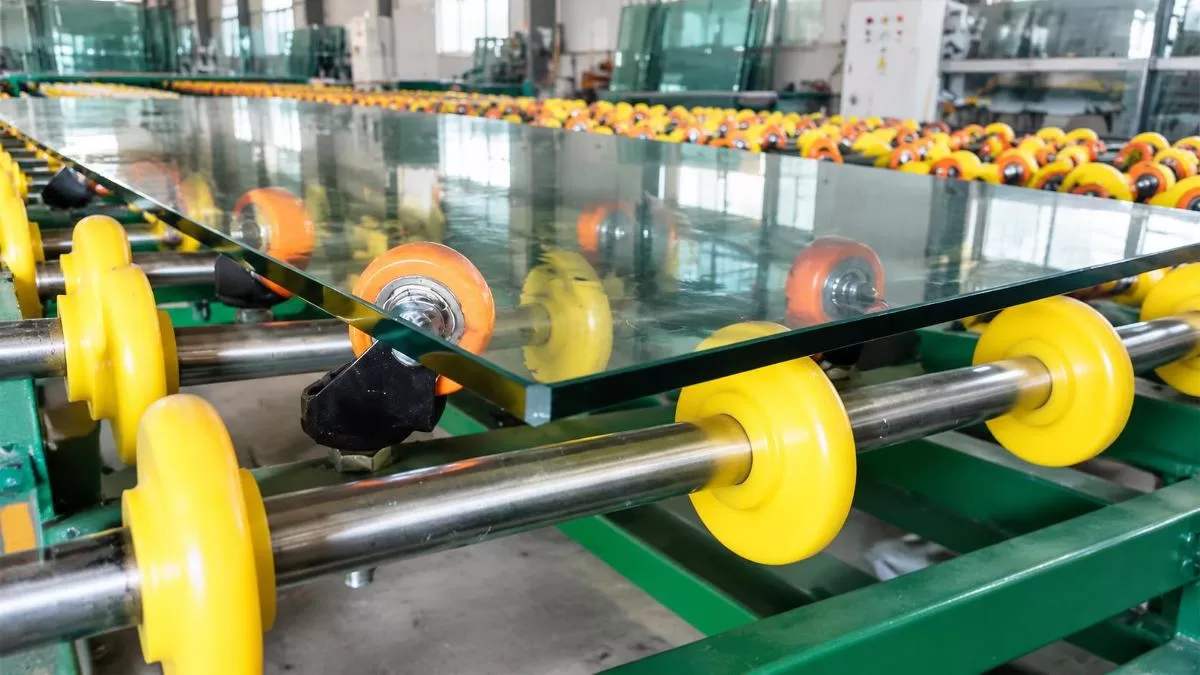
Double edger designs, including models like the YD-DE, are intended to support consistent squareness tolerances through fixed parallel spindle geometry rather than manual single-pass handling. The specific intake alignment method, such as mechanical squaring fences, depends on the individual machine's design and should be confirmed against the selected model's specifications.
In a double-edge grinding pass, opposed parallel spindle arrays grind both sides of the glass at the same time. This fixed geometry is intended to keep the trailing and leading widths aligned, which supports the diagonal dimension matching needed for insulated glass unit assembly, with actual results depending on machine calibration and glass handling.
Engineering Profile: Horizontal Glass Double Edger Machine YD-DE Capabilities
For manufacturers seeking higher productivity, the Horizontal Glass Double Edger Machine YD-DE series, according to the manufacturer's product data, provides an integrated platform for parallel continuous edge processing. Designed to complete rough grinding, fine grinding, and polishing in a single pass, the YD-DE is intended to reduce the need for intermediate staging between these steps.
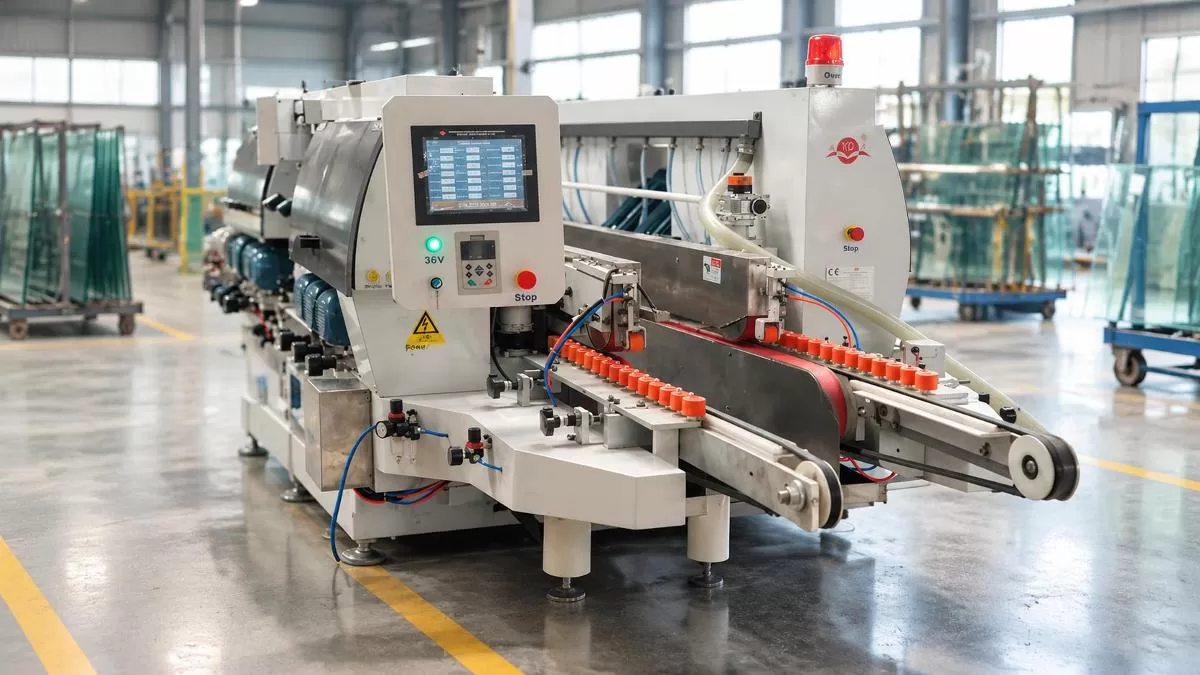
According to the supplied specifications, the machine handles glass thicknesses from 3 mm to 20 mm, with an overall feed speed range between 0.8 and 8 m/min. The YD-DE accommodates minimum glass sizes of 200 mm and reaches maximum widths from 1500 mm to 4000 mm depending on model selection. With a listed weight of 4000 kg to 6000 kg and built on linear guide rails with screw rod transmission, it houses 18 to 20 spindles, carries a listed power rating of 46 kW to 50 kW, and has a compressed air consumption below 1 liter per minute.
Critical Selection Parameters for Factory Deployment
Selecting appropriate automatic glass polishing machinery requires aligning line mechanics with the intended manufacturing profile. Plant engineers should assess several operational factors to match machine specifications with production goals.
Glass Thickness Flexibility and Feed Speed Scaling
Processing mixed thicknesses requires mechanical flexibility across the line. Thinner glass generally calls for gentler conveyor pressure to avoid substrate bowing, whereas thicker structural lites generally demand higher spindle torque, though the precise balance depends on the specific machine and tooling in use.
The YD-DE series carries a supplied overall feed speed range of 0.8 to 8 m/min across its 3 mm to 20 mm thickness capacity. The appropriate operating speed within that range depends on the glass thickness, the amount of edge material being removed, the tooling installed, and process trials conducted on the specific line, and should be set according to the manufacturer's operating guidance rather than a fixed universal figure.
Spindle Count Considerations: 18 to 20 Spindle Configurations
Spindle counts affect edge throughput and the range of processing steps a line can perform, making spindle layout a central consideration during plant design. According to the supplied specifications, the YD-DE series offers a total spindle count ranging from 18 to 20, with the configuration described as customizable.
-
Overall spindle range: the YD-DE series spans 18 to 20 total spindles depending on the model selected.
-
Customizable functions: spindles can be configured for functions such as corner cutting, pneumatic polishing, film removal, and safety arris processing, according to the manufacturer's product data.
-
Configuration confirmation: the specific arrangement of grinding, resin, and polishing stations within a given spindle count should be confirmed with the manufacturer for the selected model, since the supplied data does not map individual spindle functions to the 18 or 20 count.
Integrated film-removal spindles, where included in a configuration, are intended to strip metallic coatings off Low-E glass along the perimeter, helping secondary IGU sealants bond to bare glass.
Coolant Management: Integrated Water Circulation and Glass Dust Settling
Glass grinding generates fine, abrasive particulate slurry that can damage mechanical components and stain finished glass surfaces if recirculated unfiltered. High-volume systems, including the YD-DE's integrated water circulation system, are designed to route coolant to abrasive contact zones according to the manufacturer's product data.
Depending on the circulation system installed and the manufacturer's guidance, water clarification before recycling may involve settling tanks, weir plates, centrifugal separators, or chemical flocculant dosing. Supplying clean, cooled water to spindle faces helps control wheel thermal load, supports diamond wheel life, and keeps polishing surfaces clean.
Automation Integration: Dual-Mode PLC Systems and Line Synchronization
Many glass facilities link cutting tables, edge polishing systems, and washing machines into continuous production channels. Centralized PLC systems coordinate conveyor feeds across linked units using integrated sensor networks.
The YD-DE series features a complete PLC-controlled interface with the flexibility to switch between automatic and manual operation modes, according to the manufacturer's product data. Interconnected PLCs across a production line help the double edger match upstream line speeds, which supports preventing conveyor jams and idle spindle intervals.
Routine Maintenance and Quality Troubleshooting in High-Volume Operations
Unscheduled machine downtime can stall upstream cutting cycles and leave tempering furnaces idle. Structured preventive maintenance routines, carried out according to the selected machine's manual and the manufacturer's recommended schedule, help preserve processing accuracy and support consistent edge quality across long shifts.
Preventing Edge Chipping and Burn Marks at High Feed Rates
Edge chips and friction burn marks often signal unbalanced tool engagement or coolant starvation. If coolant delivery pressure drops, localized frictional heat can micro-fracture glass boundaries and scorch diamond resin matrices. The following checks reflect common practice in glass edge processing; exact methods and intervals should follow the specific machine's operating manual.
-
Inspect coolant delivery nozzles regularly to clear glass sediment and ensure unobstructed flow directly onto the grinding wheel face.
-
Set the mechanical stock removal depth on primary coarse wheels according to the glass specification, tooling selected, and the machine manufacturer's operating guidance, rather than a fixed universal figure.
-
Redress glazed resin-bond diamond wheels using a dressing method recommended by the wheel or machine manufacturer to expose fresh diamond grits and restore cutting efficiency.
-
Check that drive motors across the spindle set share edge cutting loads evenly, using whatever monitoring method the machine's control system provides.
Calibrating Linear Guide Rails and Conveyor Roller Wear
Conveyor drive belts and polyurethane support rollers face constant abrasive exposure from glass dust and ambient moisture. As track roller surfaces wear unevenly, glass sheets can tilt, throwing safety arris chamfers out of alignment.
Technicians should check track squareness and roller condition on a schedule set by the machine manufacturer. Maintaining the linear guide rails and screw rod transmission confirmed for the YD-DE series, along with periodic lubrication where specified, helps keep positioning tolerances tight and reduces the risk of edge tapering across long production runs.
Pneumatic System Checks for Consistent Polishing Clarity
If pneumatic edge polishing stations run under uneven or poorly maintained air supply conditions, finished edges can show uneven surface sheen. Excessive contact force can burn the polishing wheel, while insufficient force may leave cloudy patches.
Daily Pneumatic Verification Protocol:
[Main Air Supply: confirm against manufacturer-specified pressure setting]
       │
       ├──> [Air Consumption Check: verify consumption stays within the supplied <1 lt/min figure]
       │
       ├──> [Piston Movement Check: Clear slide rails of glass fines]
       │
       └──> [Edge Visual Audit: Confirm consistent luster across leading and trailing borders]
Air pressure and air consumption are separate specifications and should not be substituted for one another; the operating pressure setting should be confirmed against the machine manufacturer's documentation rather than assumed. Regulating supply pressure correctly helps balance polishing wheel contact force, compensating for gradual pad wear without burning the substrate. Checking air lines regularly helps protect finished edges from chatter marks and optical cloudiness.
Daily Maintenance Protocols for Water Recirculation Slurry
Allowing ground glass fines to build up in water tanks turns cooling fluid into an abrasive mixture that can score edge finishes and clog internal pipe runs. Plant personnel should drain sediment compartments and clean suction filters on a regular basis.
Monitoring coolant cleanliness helps preserve the open-pore structure of abrasive wheels, reducing the risk of premature wheel glazing. Clean recirculating coolant helps stabilize polishing temperatures and limits glass particulate buildup on downstream washing machine rollers.
Frequently Asked Questions (FAQs)
What is the primary difference between a double edger and a straight-line single edger?
A double edger is designed to process two parallel glass edges at the same time in a single machine pass, using an automated transport mechanism and synchronized spindle rows, as confirmed for the YD-DE series. A straight-line single edger commonly processes one edge per cycle, which can require manual handling and multiple cycles to finish a rectangular lite, depending on the specific machine. Double edging lines generally reduce labor input and can support improved squareness and dimensional parallelism, though exact outcomes depend on the machine and setup.
Why is pneumatic compensation used on polishing spindles?
Polishing wheels made of polyurethane, felt, or similarly compliant materials compress during operation and can wear down faster than rigid metal-bonded diamond tooling. Rigid mechanical spindle advances would require frequent manual tool adjustments to offset this wear.
Pneumatic cylinders are intended to deliver a continuous, cushioned load that keeps the wheel face resting evenly against the moving glass edge despite progressive tool wear, according to the manufacturer's product data for configurations that include pneumatic polishing spindles.
How does edge polishing quality relate to the glass tempering process?
Cutting flat glass can leave edge flaws. Tempering can create transient tensile stresses during early heating, and severe edge flaws can contribute to premature fracture under those stresses.
Fine grinding and polishing passes are intended to reduce edge flaws, which is generally associated with a smoother edge and can lower the risk of panel breakage during tempering, though outcomes depend on processing quality and glass condition.
What water filtration approaches are used with automatic glass polishing machinery?
Coolant water circulation systems are generally intended to keep glass particulate out of suspension to avoid wheel face contamination and finish haze, though specific filtration thresholds depend on the circulation system installed and the manufacturer's guidance rather than a single universal figure.
Depending on the system, recycling tanks may use settling weirs, hydrocyclones, or chemical flocculants as options to remove particulate from the water. Maintaining steady water delivery to the grinding and polishing zones helps keep diamond wheels cool and reduces the risk of thermal micro-cracking.
Can automatic glass polishing machines process coated or Low-E architectural glass?
Double edgers can be configured to process Low-E coated glass when equipped with edge-deletion spindles, a customizable function noted in the YD-DE product data. These specialized grinding wheels are intended to strip away the metallic coating along edge margins, leaving clean surfaces for structural bonding sealants.
Transport systems on these lines commonly use soft, non-marking materials to move coated glass surfaces without scratching sensitive coatings, though the specific belt or drive type depends on the machine model.
Conclusion: Maximizing Fab Throughput with Automated Edge Finishing
Operating a high-yield glass manufacturing facility means balancing fast cycle times with reliable structural outcomes. Investing in capable automatic glass polishing machinery can help reduce edge processing bottlenecks, support diagonal squaring accuracy, and, when properly maintained and operated, lower the risk of glass rupture during tempering. Fabricators handling architectural curtain wall units, commercial storefronts, and interior components rely on sturdy mechanical bases, linear guide transmissions, and multi-spindle cascades to support long-term production reliability.
LIAODA (LAD) Glass Machinery Co., Ltd. brings decades of industry experience to the manufacturing of glass cold and hot processing equipment. Originating in the 1990s and operating as Yuanda Glass Machinery before rebranding in 2005, our Foshan-based manufacturing facilities build systems used across more than one hundred countries and regions worldwide. For us, long-term machinery value centers on durable construction, precise guide rail mechanics, and dedicated global customer service.
Choosing the right horizontal double edger configuration and following structured spindle maintenance supports continuous manufacturing accuracy. High-speed automatic glass polishing machinery helps turn raw scored glass lites into polished, defect-reduced glass panels, supporting the production yields that modern architectural and industrial glass processing applications require.
CONTACT US


LIAODA (LAD) Glass Machinery Co., Ltd.
We are always providing our customers with reliable products and considerate services.
If you would like to keep touch with us directly, please go to contact us
-
![Home]()
Home
-
![Tel]()
Tel
-
![Email]()
Email
-
Share
-
![Contact]()
Contact


