
The Physics of Surface Preparation in Insulating Glass Machinery: Vertical Washing Mechanics
- By:LiaoDA
- Date:2026-09-19
The Core Problem of Adhesion in Sealed Glass Units
Manufacturing double or triple-pane units requires absolute surface perfection before the sealing process begins. Any microscopic debris or residual moisture trapped between panes will eventually cause fogging or seal degradation. Modern insulating glass machinery relies heavily on the pre-treatment phase to prevent these catastrophic failures.
The washing stage is not merely about aesthetics but a strict physical requirement for molecular adhesion. When sealants like butyl are applied to the glass perimeter, they need a chemically clean substrate. Without this pristine surface, the sealant bonds to residual oils rather than the glass matrix.
Thermal expansion and contraction will later tear this weak bond apart. Once the primary seal is breached, ambient humidity enters the cavity. The desiccant becomes saturated rapidly, leading to the dreaded internal condensation that ruins the thermal performance of the window.
This is exactly where the vertical washing and drying machine intervenes. It serves as the critical gatekeeper in the production line. If a pane passes this stage with even a micron of contaminant, the subsequent insulating processes are entirely compromised.
Gravity and Drainage Dynamics in Vertical Orientations
Traditional horizontal washers allow water to pool on the glass surface. This pooling creates a thicker boundary layer of liquid that downstream drying systems must work harder to remove. Vertical configurations naturally leverage gravity to accelerate fluid drainage down the glass face.
By tilting the glass slightly, typically a few degrees from true vertical, the machine ensures stable transport. Water continuously streams downward during the washing cycle. This constant evacuation of dirty fluid prevents suspended particulates from settling back onto the cleaned glass surface.
This orientation drastically changes the spatial economics of a factory floor. Horizontal lines consume massive amounts of linear square footage. Standing the glass up reduces the machine footprint, allowing facilities to deploy more compact and efficient layouts without sacrificing throughput.
Mechanical Scrubbing Through Staged Brush Configurations
The system utilizes three distinct pairs of brushes to physically agitate contaminants. The first pair tackles the heaviest particulates, such as cutting dust and coarse glass shards. This initial physical disruption breaks the primary adhesion of dirt to the glass substrate.
The subsequent brush pairs operate on the remaining microscopic films. Often, glass sheets carry trace amounts of cutting fluids or industrial lubricants. The mechanical friction from the rotating bristles generates localized shear forces, lifting these oils into the aqueous cleaning solution.
Bristle stiffness and rotational speed must be carefully calibrated. If the bristles are too rigid, they risk introducing micro-scratches, particularly on delicate surfaces like Low-E coatings. The engineering balance lies in applying enough kinetic energy to clean without damaging the substrate.
Capillary Action and Surface Tension Disruption
After the mechanical scrubbing, the glass surface remains coated in a thin film of water. Before high-velocity air can be applied, bulk water removal is necessary. The machine deploys two pairs of water-absorbing sponges to handle this intermediate phase of moisture management.
These rollers rely on capillary action within their porous cellular structure. As the wet glass passes between them, the micro-voids in the sponge material draw the water inward. This physical absorption effectively breaks the surface tension of the large water droplets on the glass.
Leaving heavy droplets on the glass would overwhelm the downstream air blades. The sponges effectively reduce the moisture from a continuous film down to a microscopic layer. This sequential reduction in water volume is a fundamental principle in efficient fluid extraction systems.
Fluid Dynamics Behind High-Velocity Air Blades
The final drying stage relies on a high-performance air blade system. Simply blowing air at a wet surface is inefficient and often just pushes water around. An air blade focuses the airflow through a narrow slit, creating a high-velocity, high-pressure sheet of air.
This pneumatic shearing force must overcome the molecular adhesion between the water and the glass. The air stream strikes the glass at a specific angle, physically stripping the boundary layer of moisture. The water is sheared off the edges before it can evaporate.
Evaporation is strictly avoided during this mechanical drying process. Allowing water to evaporate naturally would leave behind dissolved minerals and hard water stains. The air knife ensures that the moisture is mechanically displaced, preserving the absolute clarity required for optical applications.
Acoustic Management in Blower Systems
Generating the requisite aerodynamic force requires industrial-grade blowers. These turbines move massive volumes of air at extreme velocities, inherently creating significant acoustic pollution. High-frequency aerodynamic noise can create severe occupational hazards for operators working near the production line over long shifts.
To mitigate this, the blower is housed within a dedicated sound-insulation box. This enclosure uses acoustic dampening materials to absorb the specific frequencies generated by the turbine blades. The structural design prevents sympathetic vibrations from transferring to the main machine frame.
Effective acoustic management transforms the factory environment. A quieter working area reduces operator fatigue and improves communication on the floor. Managing sound pressure levels is a critical, yet often overlooked, component in the design of heavy industrial processing equipment.
Material Selection for Corrosive Environments
Glass washing inherently creates a highly corrosive local atmosphere. Constant exposure to atomized water, cleaning agents, and varying temperatures accelerates the oxidation of standard carbon steels. To combat this, the machine utilizes stainless steel for all water tanks and structural covers.
Stainless steel relies on a passive oxide layer of chromium to prevent rust formation. Even when physically scratched, this layer instantly reforms in the presence of oxygen. This metallurgical property ensures the structural integrity of the machine over decades of continuous exposure.
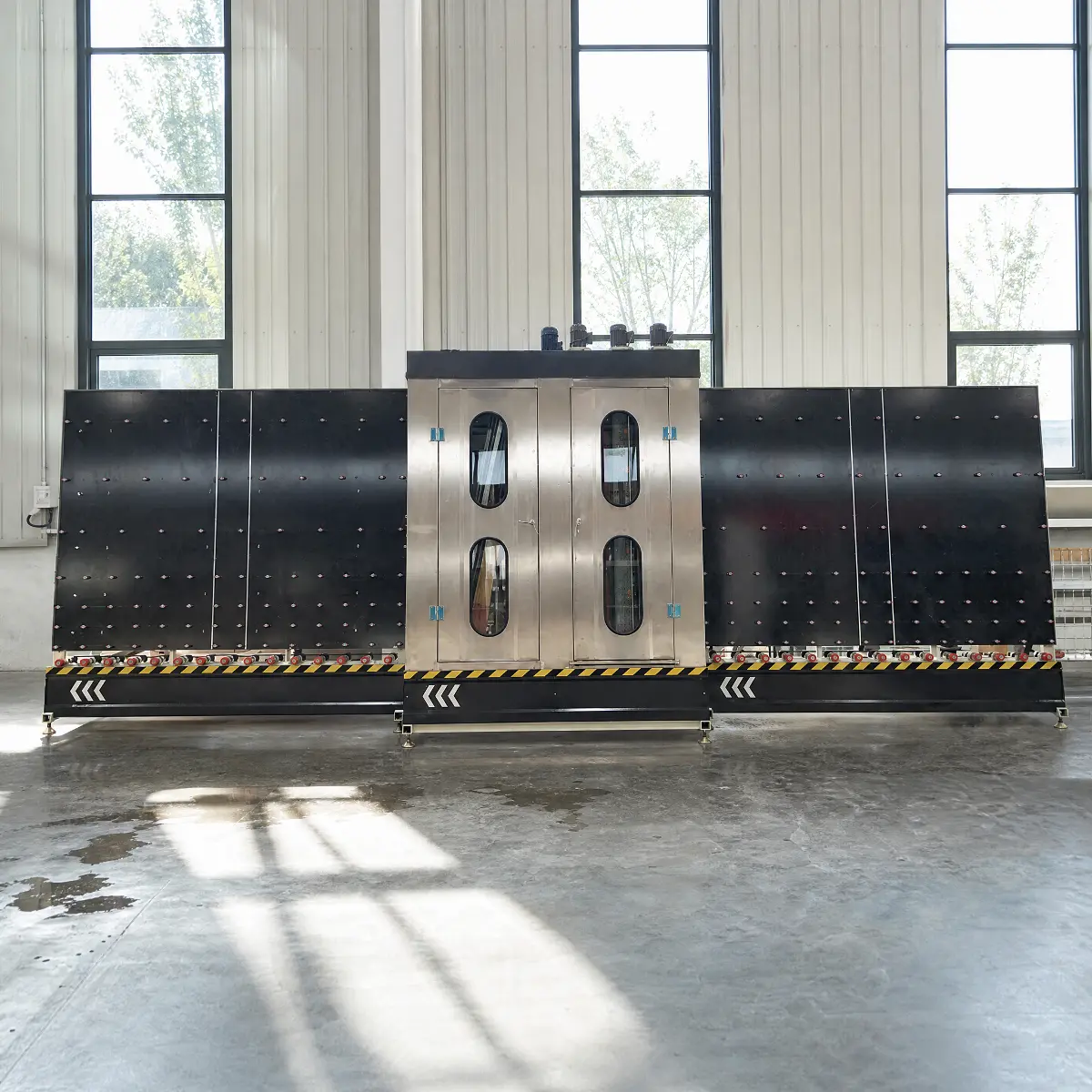
The internal glass rack, which makes direct contact with the moving sheets, is constructed from aluminum. Aluminum naturally resists aqueous corrosion while keeping the moving structural mass relatively low. This combination of materials provides a robust defense against industrial degradation.
Speed Control Variables in Production Lines
Throughput requirements dictate that cleaning equipment must adapt to the pace of the wider factory. The system offers operational speeds ranging from one to six meters per minute. This flexibility allows operators to match the washing phase with downstream bottlenecks.
By utilizing stepless speed control or FVR systems, the mechanical drive can be adjusted without halting production. If a heavily soiled batch of glass arrives, the operator can simply dial down the speed. This increases the mechanical dwell time under the brushes.
Conversely, lightly soiled glass destined for immediate tempering can be processed at maximum velocity. This variable control ensures that energy and time are not wasted. Synchronization across the entire line is what makes an operation truly efficient and economically viable.
Glass Thickness and Structural Tolerances
Architectural demands require processing facilities to handle a vast array of glass specifications. The machine accommodates thicknesses ranging from a delicate three millimeters up to nineteen millimeters. The mechanical transport system must dynamically adjust roller pressure to grip without crushing.
When processing three-millimeter glass, excessive lateral force would induce catastrophic deflection and shattering. The transport rollers utilize calibrated springs and dampeners to maintain a gentle but firm hold. This allows thin sheets to remain perfectly vertical against the aggressive cleaning forces.
For nineteen-millimeter structural glass, the challenge shifts to mass management. A large sheet of this thickness carries immense weight and momentum. The driving motors and gearboxes are engineered to handle these heavy dynamic loads without slipping or stalling during the wash cycle.
Evaluating Minimum Size Constraints
Handling small form factors presents unique challenges in vertical transportation. The minimum accepted glass size is three hundred by three hundred millimeters. Pieces smaller than this risk falling between the transport rollers or becoming lodged in the internal brush mechanisms.
When a piece bridges the gap between drive rollers, it must maintain constant contact to move forward. The spacing of the internal vertical racks is precisely engineered to support this specific minimum dimension. This strict geometry prevents operational jams and costly machine downtime.
Operators must strictly adhere to these dimensional limits to maintain fluid continuous processing. Attempting to wash undersized offcuts will disrupt the mechanical flow and potentially damage the internal scrubbing elements. Predictability in material sizing is essential for steady-state manufacturing.
Technical Specifications Matrix
Understanding the exact capabilities of different models allows for precise equipment selection. For us, matching the physical dimensions of the machine to the typical product mix is a foundational step. Over-specifying consumes excess power, while under-specifying creates permanent production bottlenecks.
Below is a structured breakdown of the core technical parameters across the three primary configurations.
| Specification | YD-VW-1500 | YD-VW-2000 | YD-VW-2500 |
|---|---|---|---|
| Maximum Glass Width | 1500mm | 2000mm | 2500mm |
| Minimum Glass Size | 300×300mm | 300×300mm | 300×300mm |
| Glass Thickness | 3~19mm | 3~19mm | 3~19mm |
| Transport Speed | 1~6 m/min | 1~6 m/min | 1~6 m/min |
| Total Power Consumption | 18kW | 18kW | 22kW |
| Equipment Weight | 1400kg | 1800kg | 2200kg |
The table highlights the scaling of power and weight as the maximum width capacity increases. The fundamental cleaning mechanics remain identical across the range. The variance lies purely in the structural span required to handle larger architectural glass formats.
Power Consumption and Mechanical Drive Efficiency
Running heavy industrial equipment involves significant continuous electrical load. The smaller models draw eighteen kilowatts, while the widest variant requires twenty-two kilowatts. This power is distributed among the drive motors, brush rotation mechanisms, water pumps, and the high-velocity drying blower.
The blower itself typically consumes the largest percentage of this electrical budget. Moving massive volumes of air through a restricted slit demands high-torque continuous operation. Ensuring the electrical infrastructure of the facility can support this sustained load is a mandatory prerequisite.
Efficient power utilization is achieved through precision bearings and low-friction transport mechanics. By reducing parasitic mechanical losses within the drive train, more electrical energy is converted into actual cleaning force. This engineering focus keeps operating costs manageable over the machine's lifespan.
Fluid Dynamics of Recirculating Water Systems
While the mechanical scrubbing lifts the dirt, the water acts as the primary transport medium to carry it away. The fluid dynamics within the washing zone require high-volume spraying to constantly flush the brush bristles. Without this flushing, the brushes would simply redistribute the dirt.
The nozzles directing the water flow must be positioned to optimize the impact angle against the glass. The kinetic energy of the spray assists in breaking down persistent surface films. It also ensures that the bristles remain lubricated, preventing excessive friction and heat buildup.
Inside the stainless steel tanks, the dirty water undergoes rapid settlement and filtration. Heavy particulates sink to the bottom while finer debris is caught by inline mesh screens. This recycling mechanism minimizes total water consumption while ensuring only clean fluid reaches the nozzles.
The Role of Variable Frequency Drives
The integration of Variable Frequency Drives fundamentally changes the nature of mechanical control. Instead of relying on crude mechanical gears to change speeds, the electrical frequency supplied to the motor is precisely modulated. This allows for incredibly smooth acceleration and deceleration profiles.
Smooth motion is critical when transporting heavy, fragile materials. Sudden jerks in the drive line can cause large sheets of glass to slip on the rollers or shatter completely. The stepless speed control ensures that kinetic energy is transferred to the glass safely.
Operators benefit from an intuitive control interface that responds instantly to production variables. If the glass exiting the machine requires more thorough drying, a minor adjustment to the drive frequency slows the transport. This precise tuning capability maximizes both electrical efficiency and output quality.
Application Scenarios in Modern Facilities
Architectural demands require this equipment to perform flawlessly across multiple distinct manufacturing environments. Processing facilities integrate these units into various workflows to solve specific surface preparation challenges. The primary deployment environments include:
- Architectural glass processing for building facades.
- Pre-treatment checkpoints for glass tempering preparation.
- Continuous industrial glass manufacturing lines.
- High-volume glass cleaning and distribution facilities.
When fabricating large facade elements, the glass must move seamlessly from cutting to washing. Any delay or inefficiency here ripples throughout the entire shift, drastically reducing the daily output of the plant. Precision equipment is required to maintain this critical flow rate.
In high-volume manufacturing lines, equipment durability becomes the paramount concern. A machine must run continuously for multiple shifts without mechanical degradation. The robust combination of stainless steel construction and heavy-duty blowers ensures that routine maintenance does not impede aggressive production schedules.
Common Technical Misconceptions
Even experienced operators can harbor misunderstandings regarding glass washing physics. Clarifying these technical points ensures the equipment is utilized to its maximum potential.
Q: Does increasing the brush pressure always result in cleaner glass?
A: No, excessive pressure simply flattens the bristles against the glass. The cleaning action relies on the tips of the bristles sweeping the surface. Flattened bristles lose their kinetic impact and only smear contaminants, while simultaneously accelerating mechanical wear on the core.
Q: Should the air blade blow heated air to evaporate the water faster?
A: The primary function of the air blade is mechanical displacement, not thermal evaporation. Heating the air offers minimal benefit and can actually cause trace minerals in the water to bake onto the glass before they are blown off. Ambient high-velocity air is vastly superior.
Q: Are the water-absorbing sponges purely for drying?
A: They act as a critical intermediate moisture phase. They do not fully dry the glass but reduce the bulk water mass. If they were bypassed, the volume of water hitting the air knife would cause excessive splashing and droplet atomization inside the cabinet.
Integration with Downstream Processes
Proper integration of these systems is the hallmark of sophisticated insulating glass machinery layouts. The washer must feed directly into the assembly station without manual handling. Every human touch introduces the risk of oil transfer, entirely defeating the purpose of the rigorous cleaning cycle.
Glass tempering preparation represents another highly sensitive application scenario. If oils or dust remain on the glass as it enters the tempering furnace, the intense heat will permanently fuse these impurities into the surface. The washing phase acts as the final quality control checkpoint.
Users constantly face the dilemma of choosing the right footprint and capacity for their specific needs. Understanding the daily volume and maximum glass dimensions dictates the required model size. Oversizing creates unnecessary spatial and financial burdens while undersizing limits future production capabilities.
Sustaining Quality in Final Assembly
The ultimate objective of any processing line is to deliver a flawless final product to the construction site. The integrity of a building's thermal envelope relies heavily on the quality of the glass units installed. Surface preparation remains the invisible foundation of this quality.
Every component, from the sponge rollers to the acoustic insulation, plays a specific engineered role. Skipping steps or compromising on equipment maintenance inevitably leads to latent defects. The physics of adhesion are unforgiving, demanding strict adherence to established cleanliness protocols on the factory floor.
Investing in high-grade processing equipment is a commitment to long-term operational reliability. By trusting well-engineered insulating glass machinery, fabricators can confidently guarantee their products against premature seal failure. The meticulous removal of microscopic contaminants is what separates standard glass from high-performance architectural solutions.
CONTACT US


LIAODA (LAD) Glass Machinery Co., Ltd.
We are always providing our customers with reliable products and considerate services.
If you would like to keep touch with us directly, please go to contact us
-
![Home]()
Home
-
![Tel]()
Tel
-
![Email]()
Email
-
Share
-
![Contact]()
Contact


